
Today’s car designs are based on the same design concepts of decades past; we can’t declare that there is disruptive innovation in the car manufacturing industry, only a few changes that are added along with the launch of new models such as adding features or altering the design lines. However, designers’ roles are not limited to responding to the market needs and requirement. The role of designers also extends to trying to solve problems that existing users don’t notice, understand, or even simply accept in terms of existing products and services.
Furthermore, designers should be able to observe the future and try to solve expected problems that may occur in the future through new innovation and ideas. However, we can’t achieve disruptive innovation with the same roles and guidelines used to design existing products such as vehicles. We may need to throw these roles away and start thinking again from scratch based on the contemporary, human-centered design theories and user experience principles.
IDEO, the leading organization in human-centered design, started a project to envision the future of automobility. The project aimed to design a car that responds to the future needs of car drivers and how to reflect these needs in innovative car design models. Ricardo Figueiroa, IDEO industrials designer, describes the project in an interview with Design Boom magazine:
“As business models, technical innovations, and user needs evolve, we expect to continue to see many exciting developments in the transportation and mobility domain." -Ricardo Figueiroa, IDEO
The project presents three different design concepts, each concept providing a solution for specific segments of future car drivers and how the driving – or the self-driving car – experience can be formed to meet with future needs. The three concepts target family needs, work needs, and delivery needs.
IDEO Commuter: The Family Car
The future family car is an intelligent one, it has proximity sensors installed in the car so that once you are less than 100 meters away, it starts to sync information from your different devices and their applications such as email, calendar, and text messages to learn where you want to go and the best directions to take. Once the car moves to the road, it starts to sync this information with other cars that are moving in the same direction in a process called “platooning.” This process aims to set the speed of the car and the usage of brakes based on the rest of the cars in front of it.
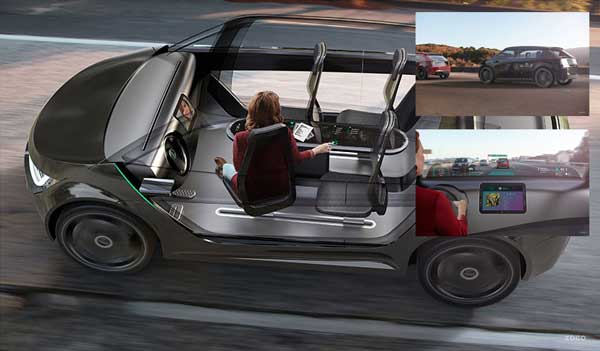
The commuter car is supported with green lights on both the back and sides to let other drivers identify with linked cars. Another rainbow-hued light is highlighted with the usage of the brakes. The interior of the driverless car is different from that of existing cars, as it provides larger windows, a bigger console that acts like a table, and rotating chairs.
IDEO Cody: The Transparent Delivery Truck
The IDEO Cody is a new concept for delivery trucks with a transparent body and frame supported by carbon composite. The new car would work with services such as Amazon, UPS, DHL, and others to provide a real-time delivery experience. Using artificial intelligence, the car can automatically determine the destination and see the fastest route to deliver the order. The user can easily change the delivery address using a simple mobile application.
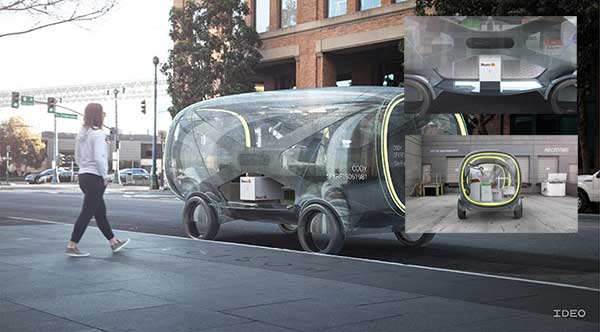
The Cody concept has a vacuum surface to allow for the stable placement of packages. There is a robotic hand inside the car that organizes the packages for optimal utilization for the space. The robotic hand can deliver the shipment to the consumer after scanning their face to ensure the client’s identity.
IDEO WOW: Work On Wheels
Can you imagine that your office comes to you every morning instead of you commuting to it? The IDEO WOW - Work On Wheels - concept provides a car concept for a movable workplace. The interior of the WOW car is designed like an office with interactive table and chairs; it allows employees to move their workplace to different locations such as sea or garden to increase productivity. At the end of the working day, the WOW car can return to the office hub to recharge and get ready for the next day.
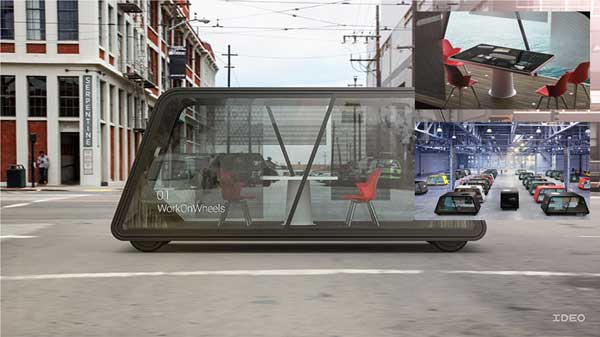
The IDEO WOW idea is little bit strange and controversial for many, as you can simply grab your computer and move to any place to work remotely. But the new concept can be used in some implementations such as delivering services to people in their cities without traveling to service centers. It also has potential for promoting products and for businesses where employees need to commute from one place to another.
IDEO video overview for the three car concepts.
Concluding Thoughts
The above three concepts explored how to use human-centered design and disruptive innovation to change the way we think about cars and auto design. Although each concept provides a solution for a specific segment of users, ideas can merge together or be modified to develop these concepts further.
Some concepts may look controversial, but igniting creativity could allow other designers to think in a similar manner not only in the automobility, but also in other product design fields.





there's no human on this video... nice design but scary future. Looks like a student project, where is the social aspect of this proposal for the future. Why mobility should be still focused on 4 wheels boxes with trendy leds light motion. Sorry but this looks poor to me and easy "shiny" communication.
This is very interesting observation David. I like the term "scary future." the project disrupts the idea that it is the time for change. While, the climate is changing and how to use things have changed over the last two centuries, our design philosophy should change as well. However, I agree with you this change should consider human being ethnology. We can't just pretend we are creating the future of design and the result is minimizing the human role. This is a fact that we should consider in our design thinking as well.
Thanks a lot for you reply, start then to be a rich discussion then :). The point I would like to high light for your creative audience minds is: we can be easily disruptive with technology usage, but social behaviours and practices only evolve (continuous improvement looking for trust). This is an important criteria of success to avoid conflict and help people subscribe for a different way of living. Design thinking is a very productive methodology, but only 3 to 6 % of upfront innovation projects reach production step, in most of the industries. Speaking about the future of Design, I personally believe that we should be more and more facilitators of cross fertilisation : being an ambassador to connect different companies and any enablers that develop and produce objects (connected) to support different services that enables unique and relevant experiences for each. Being sustainable is a criteria of success. (sorry for my english) Design Thinkers should then be company scenarists of the future to help Makers (all of us) to be inspired and connect the dots.
coming back to IDEO mobility vision, I don't see this cross fertilisation where street with signs design, urban furnitures design, cars design, but also city services design, building architectures, media contents, weather or any environmental aspects are taken as an opportunity to experience an inspirational future to help makers meet and reach a new step. This appeal to progress to me, don't you think so?
https://bigstory.ap.org/article/7142bf580e3842e7b2a9b97c229c9917/drones-getting-way-first-responders
this article is a perfect example / Design have to consider human practice and being an architect of connectivity is key to sustain smart solution for good experience. Experience harmony is the next Designer challenge beyond aesthetic. Attached to a DESIGN EXPERIENCE, delivering a scenario is a way for the designer to engage all the stakeholders in a creative and productive solution.
streets, parking lots, urban furniture, public spaces but also cloud computing and augmented reality have to be included in a such future vision of mobility. Emotion involvement have to be investigated... why to we need to move? not only because we need to be in another place.. because we need to think, to escape, to look for inspiration, to meet people...