
The ability to solve problems is one of the essential strong points inside successful organizations. Seeing the success of a companies’ innovation and creativity does not mean that everything went perfect during the production time. Each creative process or innovation to build a new product is faced with barriers and problems before and during the production time. In order to ensure project success, there should be a method that helps stakeholders to identify problems and solve them.
We discussed various types of design thinking tools in previous articles. Why these models can be used to solve problems, yet they did not focus on this particular purpose. Therefore, another set of tools is used in problem solving discussions. We will cover these tools in series of articles and the first one is the Hurson’s production thinking model.
Problem solving using Hurson’s Production Think Model was presented by Tim Hurson in this book, Think Better, published in 2007. The model consists of six stages. In each stage a specific number of questions are asked to emphasize the different sides of the problem in order to reach a better understanding for the best solution. For designers and creative people, one of the advantages of using this model over other models such as the “Simplex” and “Plan-Do-Check-Act” is that it provides a room for creative thinking and allows stakeholders to creative ways to achieve the target of each stage.
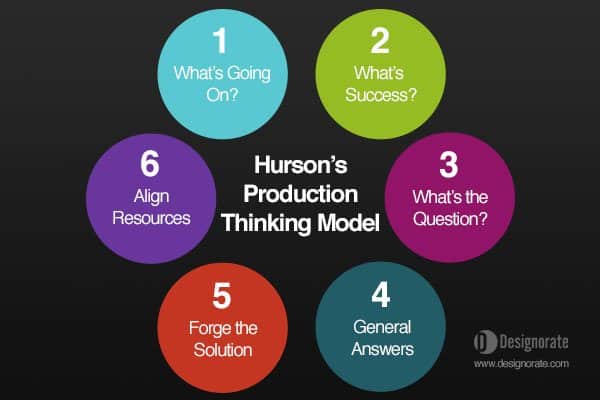
Stage 1: What’s Going On?
In order to find a solution for a problem, we have to understand it first. At this first stage, the stakeholders aim to understand the problem and the information related to it. It can be one single problem or multiple problems. In this stage, problems are isolated and each one is analyzed through number of question groups such as:
- What is the problem and how it the information related to it? This group of questions usually aims to identify the problem, what is the problem? What are the complains about it? What are the challenges that face solving it? etc.
- What is the impact of the problem on the organization? Here, the stakeholders try to ask questions aimed to understand the impact of the problem on the project or organization. Both direct and indirect impact should be addressed at this stage.
- What is the aim of solving the problem? Why would the stakeholders like to solve it and what is the vision of the future of the organization after solving the problem?
Stage 2: What’s Success?
At this stage, the stakeholders have to define success. Understanding a successful model and how to define the successful solution of the problem. In order define this successful target for the problem, four elements should be focused upon during the discussion meetings:
Do - What is the expected outcome from the problem solution?
Restrictions - What should not be included in the solution?
Values - What are the values that the solution should follow?
Essential outcomes - How do we evaluate the success of the solution?
Stage 3: What’s the Question?
Among the question asked during the discussions, specific questions are valuable and directly contribute in solving the problem. Here, the stakeholders look the questions that need to be answered in order to solve the problem. These question types vary based on the target of solving the problem. If the problem is consumer dissatisfaction, then the questions should address this problem and how to solve it. At this stage, no answers are required, the discussion focus is on the questions that directly lead to solving the problem.
Stage 4: General Answers
After identifying the right questions to address, the focus should be on the answers. Stakeholders try to answer these question in a sense of solving the problem. The answers are discussed in order to reach the best solution that can achieve the organizational target. The list of answers should be collected without excluding any one. Each answer can be a potential solution for the problem. It is like brainstorming for different solutions and collecting them for further analysis.
Stage 5: Forge the Solution
After collecting all the possible answers, each answer is evaluated and compared with the targeted business goal and problem solving criteria. This stage narrows the answers to the best solutions that can be applied for the problem. Refining the solutions via choosing the best answers helps deciding the best solution for the problem.
Stage 6: Align Resources
The last step includes identifying the resources and team required to implement the solution. At this stage, the stakeholders build a plan to implement the solution and achieve a desired outcome. The plan can range between a small action plan for small projects to a formal project management plan.
Conclusion
Solving problems inside projects and organization requires the correct questions to be asked in order to reach the best answers. These answers guide the stakeholders to build an action plan that can solve the problem and achieve organizational goals. Hurson’s Production Thinking Model is one of the problem solving tools that can be applied in creative and innovative projects because it fuels creative thinking during the discussions.
Hurson’s Production Thinking Model depend on six stages that aim to narrows questions the one that help solving th problem based on a predefined criteria. Then, narrowing the answers to form a plan that can be implemented with a specific resources and team members. The tool can be used in both individual or group discussions for a wide range of projects





Leave a Reply