
Many companies claim they are designing with the end user in mind; yet too many products fail to achieve this goal. This occurs because of a variety of factors, like needing to adapt to different targets or using tools that do not achieve the target’s needs. The user-centered design process ensures that the user is targeted during all stages of product development, and that proper tools and methods are implemented to build a deep understanding of user-related information such as demographics, behavior, and product requirements. The final product or service design ensures the fulfillment of user requirements through a smooth, user-friendly experience. The term “user-centered design,” is also known as human-centered design, since both “user” and “consumer” terms are used interchangeably depending on the design field.
Based on the ISO 13407 (1999), the human-centered design process is defined as "an approach to interactive system development that focuses specifically on making systems usable. It is a multi-disciplinary activity.” In his book, “Handbook of Usability Testing: How to Plan, Design, and Conduct Effective Tests,” Jeffrey Rubin highlighted three main principles needed to achieve user-centered design:
1- Early focus on users and tasks
As the user should be placed at the core of the design process, the structure and type of information examined should reflect an in-depth understanding of the user’s behavior. This can be achieved through training designers to collect and process information.
2- Empirical measurement and testing of product usage
Measurement and testing play an essential role in ensuring the final product sufficiently meets the user’s needs. Measurement and testing should focus on the ease of learning and use of the product. Additionally, the product prototype should be tested with actual users to ensure accuracy of results.
3- Iterative design
Constant improvement and modifying contributes to increasing the product’s efficiency, meeting ever-changing client needs, and achieving market competency. This change is relevant for both sustaining and disruptive innovation models.
The User-Centered Design Process
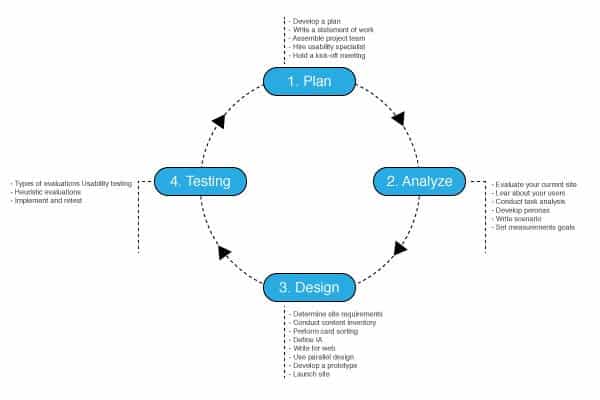
The three characteristics of user-centered design should be implemented during the design process through the four main stages of design. Each of these steps includes methods and tools meant to ensure the product achieves user-centered design. Below is an overview of these four stages:
Stage 1: Plan
In this stage, a plan is written for each of the project stages that the stakeholders will follow. Once the plan is developed, the project manager assembles the team and holds a kick-off meeting. While writing the plan and creating the team, a statement of the work is written. If the company lacks specialization, they can outsource.
Stage 2: Analyze
Following the planning stage, an in-depth analysis of the project should be made. This can be achieved through a number of methods such as: 1) evaluating the current project, 2) collecting and analyzing information about the user, 3) conducting task analysis, 4) building a persona for the target user, 5) writing scenarios, and 6) setting measurements and testing goals.
Stage 3: Design
At this stage, the design is created depending on whichever methods and tools work for each industry. In web design, for example, the design project includes designing the website, organizing and placing the content, and launching the website just like the Manchester Web Design experts do.
Stage 4: Test and Refine
The testing and refining stage includes observing the types of evaluation methods, creating a test plan, conducting tests and deciding on evolution, and finally, collecting the data and analyzing it for design improvement and development.
Once the final stage is accomplished, the testing results are used to repeat the procedure again from the first stage. The repetitive nature of the process ensures frequent developmental growth and improvement of the product.
Conclusion
Designing for a product or service user’s needs has proven to be a successful method for implementing resources and project expenses efficiently, with the end result to build a design which users can not only adapt to easily, but also love and build a relationship with. Achieving user-centered design is very challenging and requires a thorough process, starting with planning and analyzing and ending with testing and improving the final product. The user-centered design process provides a collection of methods and tools that a company can use going forward when designing products and services.





Leave a Reply