
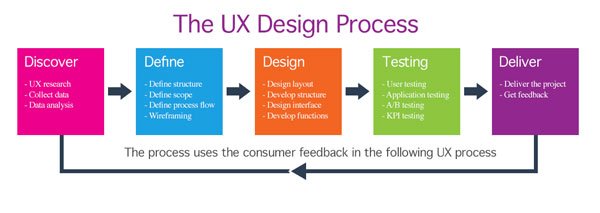
Part of the design process is to build a deep understanding about users’ behaviors and how they tend to use products or applications. This can be achieved through user experience research, a process that involves collecting and processing user data to build a product prototype with the user experience in mind. Reasoning is a common method in research that aims to reach a conclusion based on either inductive reasoning or deductive reasoning.
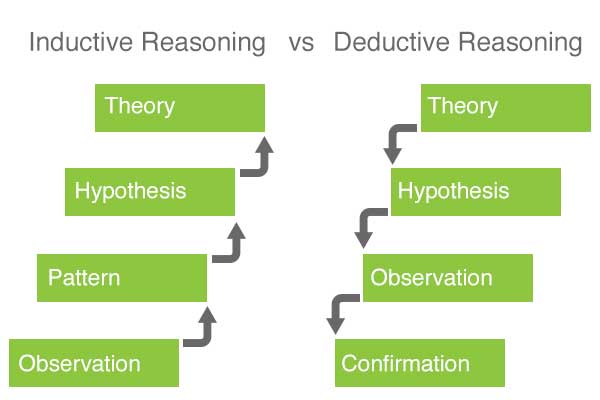
In deductive reasoning, the researcher starts with general information and moves forward to narrow the possibilities to reach a conclusion based on high certainty. An example of deductive reasoning is as follows: All mammals have brains; monkeys are mammals; therefore, all monkeys have brains. Another example: All birds have feathers; eagles are birds; therefore, eagles have feathers.
In contrast, inductive reasoning depends on an observation that leads to generalizing an idea or theory about a specific topic. So, the conclusion has a broader perspective compared with deductive reasoning. It is also known as a “bottom up” approach, because it starts with a specific case in real life that contributes to building a theory or consolation about a specific topic. Here are some inductive reasoning examples:
- Mark leaves for his office every day at 8:00 a.m., and he is always on time; therefore, Mark always will be on time if he leaves at 8:00 a.m.
- If all the winter days we have seen have been cold, then winter is always cold.
- The students in the first line are smart, the students in the second line are smart, and the students in the third line are smart; therefore, all students in the class are smart.
- All the girls we know like the color pink; therefore all the girls like color pink.
Related articles:
Types of Inductive Reasoning
Generally, there are three main types of inductive reasoning based on how each tool considers the observed information in the concluded results.
Inductive Generalization uses specific existing examples or a number of examples to draw a generalized conclusion such as observing a specific pattern and generalizing this pattern in the form of a theory. For example, the chair in office 1 is old, and the chair in office 2 is old; therefore, the chairs in the company are old.
Statistical Induction is similar to the inductive generalization. However, it is based on statistical information that predicts a specific conclusion based on numerical probability. For example: 90 percent of smokers are at risk of lung diseases; John is a smoker; therefore, John has a 90 percent chance of lung disease.
Induction by Confirmation is based on a hypothesis that is supported with an observation that makes it acceptable. Then, the hypothesis is tested by observing the evidence that supported it. For example, the police build a hypothesis about a crime, then look for evidence to support the hypothesis and confirm it.
Pros and Cons of Using Inductive Reasoning
Unlike deductive reasoning, which is based on certainty, inductive reasoning is based on probability, which can be a strong point, as it is based on observation. It can be used to establish a hypothesis in the beginning or for user experience research, as we see later. Then, the hypotheses can be refined using deductive reasoning. Another advantage of using this type of reasoning is that it allows the research to be wrong. The hypothesis can only be defined through in-depth observation of the situation in order to confirm the hypothesis.
The cons of using inductive reasoning include its limited application in the research process. As the research process aims to look for proven and precise information, this type of reasoning can’t be used in advanced stages of the research process. Another con is the observation itself, as the observed pattern or the observation process may not be correct, which leads to false results.
Inductive Reasoning and User Experience Research
One of the advantages of using inductive reasoning is that it can be applied based on incomplete information, as it is based on observation. This is one of the most important research methods in the user experience research. More understanding of user behavior can be acquired from observing how users interact with the product or application. Inductive reasoning can be used to turn these observations into hypotheses that can be used in the next steps of the design process in an early sage of the research process, based on secondary research methods such as local publications or observation as the primary research method.
For example, observing user behavior can build an understanding of how the product or application should be designed. If the researcher observed that older male users can’t see small font size, then inductive reasoning may lead to the hypothesis that all older users won’t be able to see the small font. Then, the design may consider that fact and use a proper font size for all users.
Another advantage of using inductive reasoning is the low cost required to conduct the research, as the results are based on a quick build for the hypothesis, which is based on the observation without the need for sophisticated research methods such as interviews or focus groups. In terms of the time, applying this method allows collecting and building understanding about the user without a method primary research from scratch.
Reasoning can be used to organize ideas based on the type of the reasoning applied: deductive reasoning or inductive reasoning. The decision depends on the observation of repeated patterns to build a hypothesis around this specific situation. The inductive reasoning can be used in user experience research with the observation and secondary research tools, which depends on previously collected data.
Adopting inductive reasoning helps to reduce the time and cost spent on the user experience research by depending only on the observation. It aims to build a hypothesis based on this observation, which reduces the cost of the research and the time dedicated to the research stage of product development.





Leave a Reply