
Building a user-centered design requires a deep understanding of consumer experience, which can be only achieved through an in-depth research process prior to building the first product prototype. However, as a designer, one of the common challenges when conducting user experience (UX) research is the project managers themselves. Although they never say no to user experience research, the common response includes complaints about lack of budget, time, or experience to conduct this type of research. On the other hand, freelance designers and small studios are required to apply UX research to build a better understanding to their consumers, yet they face similar problems related to cost, time, and experience.
As designers can’t work properly without understanding their consumers, a minimized level of the user experience research can be adopted to achieve this goal, which is known as guerrilla user experience. Regardless of the dictionary meaning for the word “guerrilla,” guerrilla user experience is commonly used to reflect an initiative that is done by one person or a small group on an irregular basis. If designers are faced with limitation to deploy a full user experience research project using either quantitative or qualitative methods to collect data about users, the guerrilla user experience research approach aims to collect this data under limited budgetary and time constraints by using the available information resources and research methods. This contributes to collecting data quickly with the minimum cost possible.
Pros of Using Guerrilla UX Research
The most important advantage of using guerrilla UX research is the minimal required overhead, as the research can be conduced with the designer at low cost and with no time load on the project. Additionally, the guerrilla UX doesn’t require special tools, as it depends on preexisting methods and tools. It is also portable and can be held in the office, at a café, or through the Internet using virtual meetings, Internet chats, and emails.
Cons of Using Guerrilla UX Research
On the other hand, guerrilla UX research is not expected to be as accurate as standard research due to the limited capabilities and low number of users used to collect responses. Also, the research facilitator may not be qualified to do the research or may bias the data toward a specific direction. Additionally, the limited time and budget prevents the researcher from using specific methods that consume time and budget, such as focus groups.
Methods of Conducting the Research
Before starting the UX research, the designer should be aware of the project budget and timeline which influences the research tool required to collect data and represent the sample of users taking part of the research. The representing sample can be colleagues in the office, friends, family, and exiting users who can be easily reached to collect data. Below are some of the types of methods that qualify to be used in guerrilla UX research, as it can help with collecting data within the project’s limited cost and budget.

1. Interviews
There are various types of interviews that can be conducted to collect data from existing users such as phone interviews, online interviews, and face-to-face interviews. The advantage of collecting data through interviews is that designers can collect qualitative data about products and hear personal impressions about the product directly from the users. Online interviews that can be held using chat applications or virtual rooms can help easily access users, regardless the users’ location and meeting time.
2. Surveys
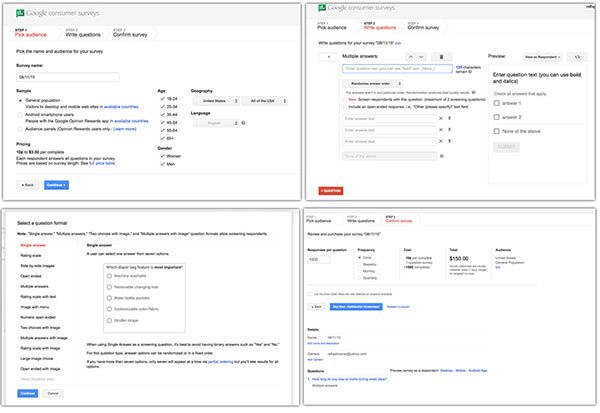
Another affordable method is the survey, which allows designers to collect quantitative data based on a pre-prepared set of questions. While there are many type of surveys, including phone survey and paper survey, online surveys are most efficient in guerrilla UX research, as they can be easily created using survey websites such as Survey Monkey or Google Consumer Surveys. Then, the survey can be shared with the representative users, or designers can pay for a specific fee per survey result. NEST is one of the case studies that deployed Google Consumer Surveys as part of the UX research process.
3. User Testing (physical and remote)
This method is very useful for software, website, and applications design. An existing version of the application or a pilot version is provided to the users to test and give feedback, which can be collected and adopted to improve the final version of the application. This method can be also applied to physical products by giving the chance to users to test the product and give feedback based on their usage. This method may be little harder to achieve in a short time compared to the other two methods, but it helps with getting feedback based on an actual test for the users’ usage of the product.
Understanding the consumers’ needs and requirements is necessary to building a successful design for products and service. However, designers face challenges to conducting a user experience research, including limited time, cost, and team members. Guerrilla user experience can provide a handy method to collect data about users within the constraints of limited resources. Smart adoption of guerrilla UX research can help designers acquire the necessary information about their users through using handy and less expensive methods such as interviews, surveys, and user testing. Hence, it is essential to choose the right representative sample to collect reflective and correct data.





Leave a Reply