
Summary: The Stage-Gate Process helps teams manage new product development through structured stages, from idea generation to launch.
Each stage is separated by gates where progress is reviewed, risks are assessed, and decisions are made to continue, revise, pause, or stop the project. Its main advantages include scalability, flexibility, customer focus, and integration with agile and lean practices. However, it can be criticised for being too linear and restrictive, which may limit creativity, prototyping, and deeper iteration.
Introduction
When developing a new product, the stakes are high in meeting goals and ensuring market and investor satisfaction. The management process should account for significant risk. Before moving between development stages, conduct a mid-check to keep production on track. This is where the Stage Gate Process is used. Stage Gate Process templates are available for download at the end of the article.
Several product development processes use waterfall, agile, lean and design thinking. The stage-gate process has been critiqued for not always addressing the creative aspect of product development, while others note its clarity due to the gate feature. Its structured, step-by-step nature differentiates it from the design thinking approach and makes it suitable for organisations with defined development processes.
What is the Stage Gate Process?
The Stage Gate Process, also known as the Phase Gate Process, guides the product development process through six main phases. The stages in the Stage-Gate are Discover, Scoping, Define Business Case, Development, Testing, Validation and Launch. There is a gate between every two stages, where the process can be tested and validated to determine whether the team should move to the next step or apply an iteration in the current step to improve before moving to the next one. Dr Robert Cooper developed the process, and in the following video, he provides a brief overview of the Stage-Gate.
In the Stage Gate Process, a manager and a steering committee decide to move from one Stage to another based on the business case, risk analysis, and other production factors such as cost, human resources, and market competence. The concept of a phase-based project evaluation originated with the American Association of Cost Engineers, which developed early versions of this process to evaluate project progress.
In 1960, NASA adopted a structured phase review technique known as the Phase Gate Process for project development management. Later, Dr Robert Cooper developed and popularised the Stage-Gate Process specifically for new product development in business contexts. Over time, the model has been updated to integrate agile and lean practices.
The number of stages can also be adjusted to fit an organisation's needs. While the process does not guarantee successful innovation, companies that are successful in new product development typically share certain principles. The process guides product development through six stages, from idea to launch, with five gates.
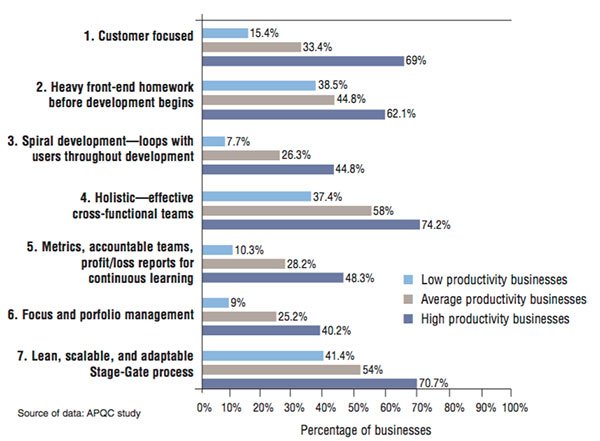
While the Stage-Gate process doesn’t guarantee successful innovation, the following principles are shared by successful companies in the new product development process (Figure 1).
- Customer-focused: The new product development is a user-centered design process. The end consumer should be placed at the heart of all the stages by solving consumer problems and providing a value proposition.
- Heavy front-end homework before development begins: Managers should have a clear, deep understanding of the project at an early stage of development, including the market, technology, and business.
- Spiral development—loops with users throughout development: The product information may change during production. Therefore, the team should be able to listen to feedback and modify the product based on the updated information.
- Holistic—effective cross-functional teams: Product innovation should be a business function that covers the whole process. It builds a shared understanding of a holistic approach to different types of innovation.
- Metrics, accountable teams, and profit/loss reports for continuous learning: Companies should be able to measure the product’s progress to evaluate production success across different stages.
- Focus and portfolio management: While many projects run within a company, the focus should be on the most effective product. A funnel approach should be adopted to eliminate weak projects and focus only on those with high potential for success.
- Lean, scalable, and adaptable Stage-Gate process: Companies should improve the new product development process to focus more on productivity and reduce time waste and paperwork.
The Stage-Gate Process
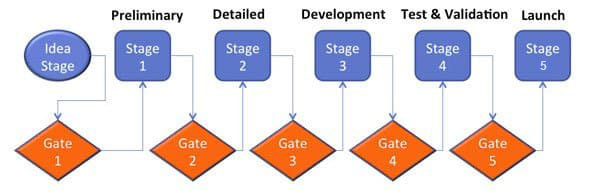
The Stage-Gate process guides product development through a number of stages from idea to launch. The standard process consists of five main stages, as follows.
Stage 0: Idea Generation
In this Stage zero of the Phase Gate Process, the team discovers the situation or project. This Stage involves the research activities required to understand the case based on clear ideas and accurate information. This Stage can include qualitative and quantitative research methods, market research, idea-generation methods (e.g., mind maps, reverse brainstorming and six thinking hats), and problem-exploration tools (e.g., SCAMPER technique, 5 Whys, and TRIZ).
Stage 1: Scoping
The team provides a clear statement of the problem. In this Stage, the team tries to determine whether the idea is viable and presents a market opportunity. This goal can be achieved through tools such as the SWOT analysis, which helps the team evaluate the idea based on strengths, weaknesses, opportunities, and threats.
Stage 2: Build Business Case
Once the idea is formed and there is a clear vision of the solution, the team works to build a product definition and analysis, a business case, a project plan, and a feasibility review.
This business case aims to convince the product stakeholders to implement the plan by building a prototype.
Stage 3: Development
In this stage, the team applies the plan formulated in the above stages and puts it into action by building a prototype for the product. The timeline for this stage is very important to achieve the five factors: specific, measurable, achievable, realistic, and time-bound (SMART). The timeline is always updated based on the production status.
Stage 4: Testing and Validation
At this stage, the prototype is tested, and feedback is collected to improve it. Testing includes team evaluations of problems, consumer field testing, and a feasibility marketing test.
Stage 5: Launch
After passing all stages, the product proceeds to launch in line with the marketing strategy. The marketing team plays a key role in creating demand and increasing exposure. The market, according to a marketing strategy. In this Stage, the marketing team plays an essential role in creating market demand and increasing product exposure.
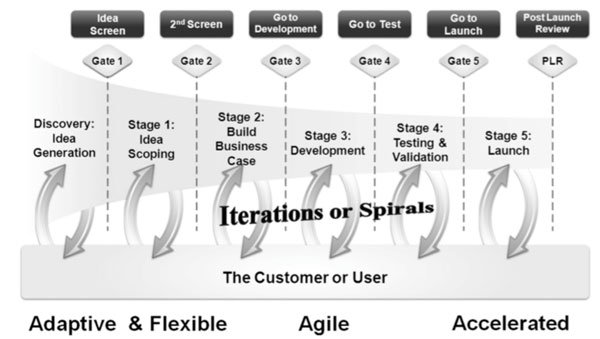
In the standard model (Figure 2), gates enable decisions to either move forward or return to a previous stage for improvement. The model has evolved into the Next Generation Idea-to-Launch System, which focuses on three targets: adaptability, flexibility, and speed, as discussed in The Advantages of the Phase Gate Process (Figure 3).
Description of the Gates
Between every two stages, a Gate is used to validate and test the outcome of each Stage and ensure it meets the requirements. The process at each Gate includes three main steps:
- Input: The deliveries from the previous Stage will be evaluated in this specific Gate.
- Criteria: The metrics and the KPIs will evaluate the deliveries.
- Output: The evaluation results and the decision to move to the following Stage or return to the previous stage.
Based on the output of the above three steps, there are five decisions based on the Stage evaluation:
- Go: The team can go to the following Stage.
- Kill: The project is not feasible enough, and it needs to end.
- Hold: the project will be halted for a specific reason.
- Recycle: A few amendments are needed before moving to the following Stage.
- Conditional Go: The development can proceed based on a conditional statement (i.e., apply specific modifications).
The Advantages of the Stage Gate Process
There is a debate about the process, at least in the design domain. The nature of the process is too strict about encouraging creative and divergent thinking. While the process doesn't guarantee successful innovation in new product development, it is remarked with the following advantages:
Iteration through Gates
One benefit of the design process is the chance to improve the product through multiple prototypes. In the Stage Gate Process, iteration is limited to stage validation. Each gate allows the team to pause and check progress. If the outcome is accepted, they proceed; otherwise, they iterate based on gate options.
Scalability
The number of stages changes based on the project's needs. Figure 4 shows how the NexGen Stage Gate Process intensifies the idea-to-launch system. The six stages above can be merged, potentially shortening the production timeline.
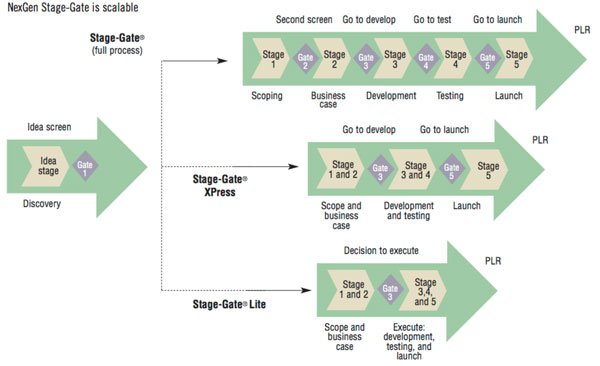
Scalability in the Stage Gate Process also relates to the organisation's size. Stage-Gate can scale to large enterprises that involve several teams and departments in product development.
Adaptive and Flexible
The new Stage Gate model uses a spiral iteration process involving the consumer at every stage. Consumers give feedback during the gates through a build-test-revise loop.
Customer-Focused
This adaptable approach leads to a user-centred design process. The consumer is central at every stage, solving problems and providing value.
Spiral Development
The product information will be changed, updated or improved during the production process. Therefore, the team should be able to listen to feedback and modify the product based on the latest research.
Agile
The updated process incorporates elements from the Agile Development system adopted in the software industry. In this model, sprints and scrums, short time-boxed deliveries can be demonstrated to the stockholders instead of documentation.
Accelerated
The updated model focuses on accelerating the development process. The stages can overlap or be shortened based on the product information and needs. The video below shows the connection between the Stage-Gate and Agile management.
The Disadvantages of the Stage Gate Process
As highlighted earlier, there is debate about Stage-Gate's effectiveness, especially in projects where teams are encouraged to provide innovative ideas or solutions to problems.
Lack of Creativity
In the design thinking process, the first Stage involves divergent thinking, where the team explore the situation and different information related to it. In the Phase Gate Process, the first Gate presents a barrier because it tends to evaluate the process at a very early stage, which may impede innovation unless the divergent thinking happened before the Stage-Gate begins.
Linear Process
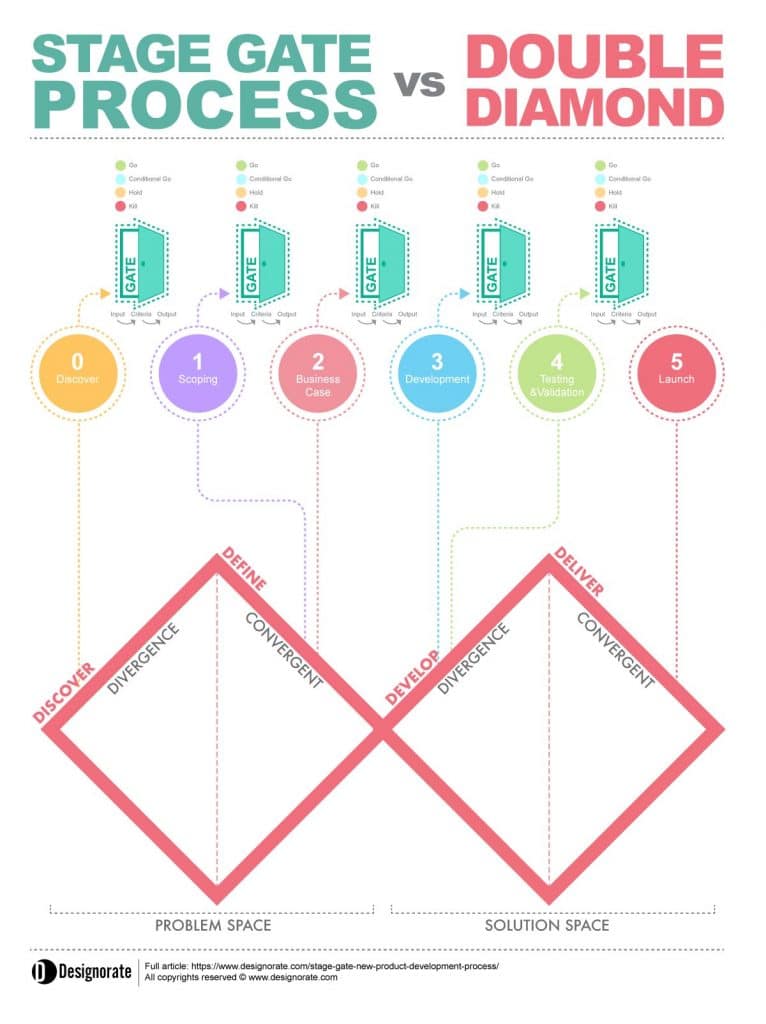
From the designers' perspective, the design thinking practice has never been linear. The move from one stage to another is not linear, yet it is more like an arena where ideas and prototypes blend. A few design thinking processes understood this, such as the Double Diamond Design Thinking.
Limited Iteration
Another issue linked to the linear nature of the process is the limited number of iterations. The move from one Stage to another is connected to Gate validation. The movement is either to the next Stage or the previous one. Compared to the Double Diamond process, the movement can jump to any stage, extending the process's iterative nature.
Lack of Focus on Prototyping
The stages in the Stage-Gate don't include sufficient opportunities to prototype and test those prototypes. While the Development and Testing stages can include prototyping, their nature implies that the testing is for final production. The Double Diamond has the Develop stage, which involves prototyping and iteration. Then, the Deliver stage includes the development, testing and delivery.
Stage Gate Process Free Template
This free Stage Gate Process template is in PDF format and allows you to add your notes and use it as a tool to manage the Stage-Gate practice within the company.
Conclusion
The Phase Gate Process can help companies develop new products regardless of company size, the project, or the number of team members involved in the production. Its ability to integrate with agile and lean management adds value to the process. The most significant advantage of the Stage-Gate Process, in my mind, is the validation Gates, which allow the team to assess the outcome of each Stage before moving to the following one.
In the NexGen Stage-Gate system, the process becomes more scalable, iterative, and consumer-engaging through the spiral, allowing consumer feedback to be collected and considered at each Stage. Also, the new NexGen Stage-Gate process can be shortened based on the product's nature. The solid nature of the Stage-Gate process makes it a reliable tool for companies to achieve innovation.
Bibliography
Cooper, R. (2006). The seven principles of the latest Stage-Gate® method add up to a streamlined, new-product idea-to-launch process. Stage-gate Inc.
Edgett J. (2015). Idea‐to‐Launch (Stage‐Gate®) Model: An Overview. Stage-gate Inc.
Grönlund, J., Sjödin, D. R., & Frishammar, J. (2010). Open innovation and the stage-gate process: A revised model for new product development. California management review, 52(3), 106-131.
Sommer, A. F., Hedegaard, C., Dukovska-Popovska, I., & Steger-Jensen, K. (2015). Improved product development performance through agile/stage-gate hybrids: The next-generation stage-gate process?. Research-Technology Management, 58(1), 34-45.





Leave a Reply