
Service design aims to improve both commercial and social services by putting the consumer in the heart of the process. Therefore, organizations that aim to achieve success and higher market position should consider improving their service through building a better understanding to their consumers. Similar to the product development process, the service design thinking follows a design process stages to turn this understanding into a new product or improve the existing product or service. The stages include understanding the consumer, defining the problem, building a prototype for the solution, and test it with real consumers.
Related articles:
- Service Design Thinking: Putting Your Consumer First
- Design Thinking in Schools: Building a Generation of Innovators
- Characteristics of Human Centered Design
The service design tools help designers and innovators to achieve the target of each stage through applying one or more tools during the research and development stages. Many design process models can be applied in the service design either for improving a commercial service or for social innovation to address existing social problems. Examples of these design process models include the following:
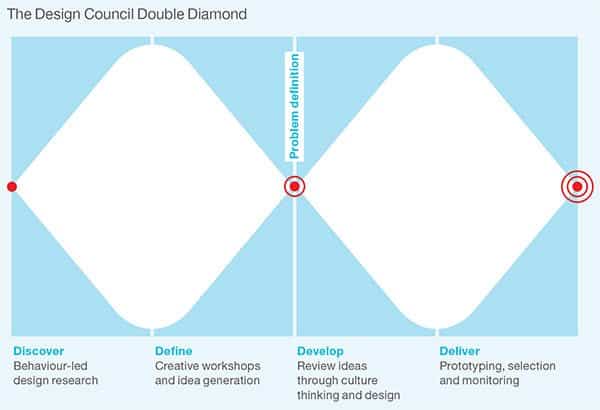
The Double Diamond. It is a design thinking model presented by the British Design Council. In this model the design process is divided into four stages; Discover, Define, Develop and Deliver. The Discover stage aims to collect information and build insight about the service as well as the consumer needs and problems. The Define stage aims to organize the finding and building a clear vision about the problem and the suggested solution. The third stage, Develop, involves building the prototype and testing it in an iterative process. And finally, the Deliver stage where the final product or service is launched.
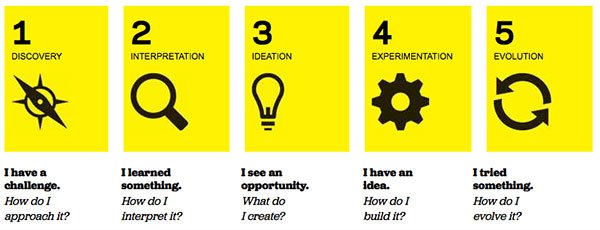
IDEO Design Thinking also includes five stages; Discover, Interpretation, Ideation, Experimentation, and Evolution. The first stage, Discover, aims to ask the right questions and research the existing problem or situation. Then, the Interpretation stage includes analyzing the collected data and organizing it. The Ideate stage transforms the research results to an idea that can address a challenge or solve a problem. The Experimentation stage aims to build a prototype for the service or the product. The Evolution stage targets iterating the idea to improve it.
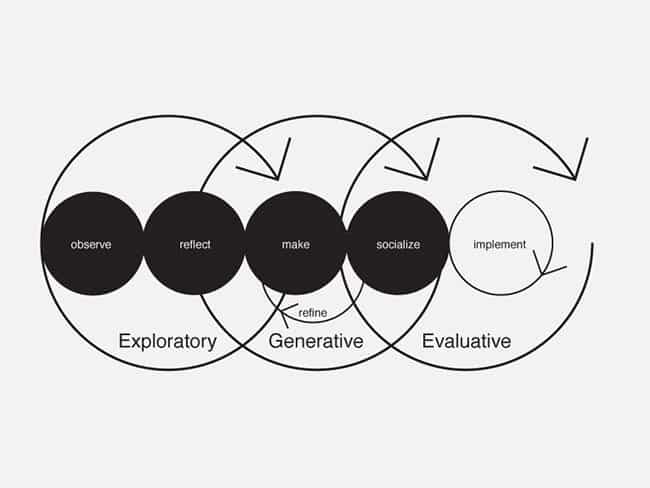
The Integrated Service Design process was introduced by Dubberly and include five stages; Observe, Reflect, Make, Socialize, and Implement. The Observe stage aims to understand the community around. The second stage, Reflect, aims to build an understanding to the problem and the suggested service design that suppose to solve the problem. The Make stage includes building the design prototype including the service specifications and documentations. The Socialize stage aims to build the network that will implement the service, it includes members from both the organization and the customers. And finally, the Implement stage aims to bring the service to life and collect feedback from real live experience by using sample size calculator.
As the above examples highlight the different stages of the design process. The below tools can help undertaking the service design process either for new service or improving the existing one.
User Diary: Early Stage Service Design Tool
The User Diary is one of the qualitative research methods that can be adopted in an early of the service design process such as the Discover stage in the Double Diamond model and the IDEO model in order to collect information about the consumer needs and understand their empathic experience over a long period of time such as number of days or weeks.
In this method, a small group of consumers is asked to record their daily experience and personal background information. These dairies can take different formats such as documents, photographs, camera recording, or audio recording. It may also include answering research questions such as basic information about the consumer.
The User Diary includes three sections; the first part includes basic information about the consumer background, the second section is filled by the consumer over the research period, and the last section may include additional questions. After collecting the data, the researcher analysis these data and prepare it for the second stage of the service design process.
There are other tools that can also be used in this stage including the Journey Maps that we covered in a previous article, the service safari, and the user shadowing.
Personas: Middle Stage Service Design Tool
After collecting data from the research sample, these data is organized in a form of a persona, an imaginary character that summarizes the target consumer demographic information, interests, needs, and problems. It can be used in the stages following to the Discovery stage such as the Define in the Double Diamond model and the Interpretation in the IDEO model.
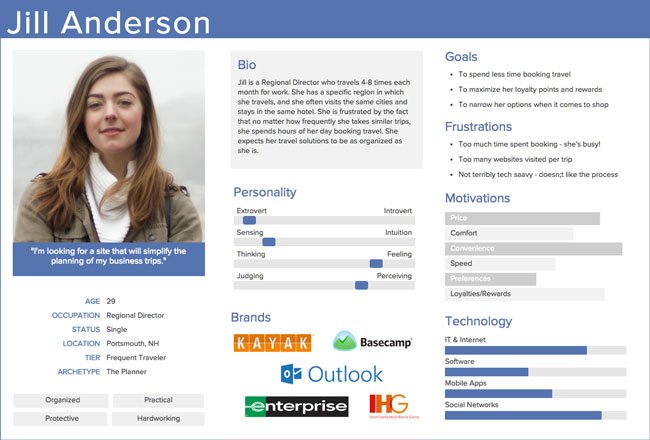
The persona may take a name of an imaginary person who represents the same characters of the research field. The aim of building the persona is to focus on the consumer during the prototyping stage and ensure that all the research data is considered during the development stages.
The persona is created in a form of document that includes information about this imaginary person and the information associated with it. If the project is multi-segment, a persona of each target consumer needs to be created.
Business Model Canvas: Prototyping Stage Service Design Tool
In most cases in the service design, the prototype describes the service that will be provided to the consumer. One of the useful tools to visualize the service project characteristics is the Business Model Canvas, which is a visual table describes the different business aspects in easy to follow and understand way.
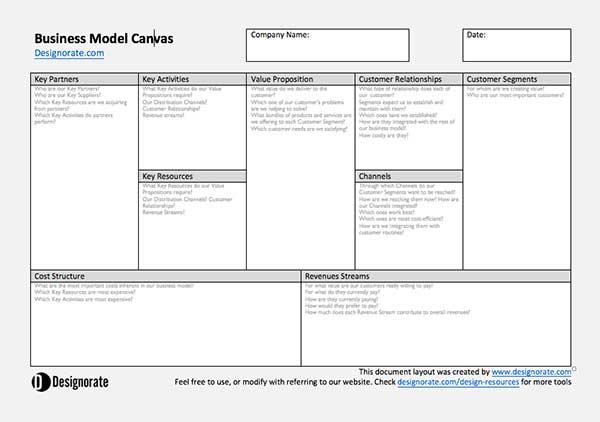
The Business Model Canvas include includes related to the key partners, key activities, value proposition, customer relationship, customer segment, key resources, channels, cost structure, and review streams. You can learn more and download Designorate Business Model Canvas in PDF format and use in service design projects.
Scenarios: Testing Stage Service Design Tool
After the iteration process and delivering the final service to the consumers. We need to evaluate the process in order to understand how to improve the service in the future. This feedback phase can use the Design Scenarios, which is a story that tries to highlight the future situation that may occur while using the service. The service can have either one or multiple design scenarios.
The Design Scenarios includes a use case of how the consumers use the service and the expected experience that they may face. These use cases are used to identify how to develop it in the future, which helps to make a decision about future actions to improve the consumer experience.
The service design process can help you to ensure that the consumer is considered in every stage of the service development. However, in order to implement the process properly, both the right persons and tools need to be used in order to ensure that this target is met. The above four tools can be used in each stage of the service design based on each stage and the required aim of it. The right application of the service design helps both commercial companies and NGO organizations to improve their offerings for their consumers.




Leave a Reply