
Achieving innovation in business requires deep understanding of the aspects of the business. This understanding is what separates success from failure, yet the focus on essential business elements may be distracted by a 50-pages business plan, as our minds are able to focus on the ideas when they are visually presented, rather than written in long paragraphs. Therefore, the business model canvas can present a useful tool for business strategists, entrepreneurs, and innovation managers to visually present essential business aspects in order to understand the strengths and weaknesses in the business plan.
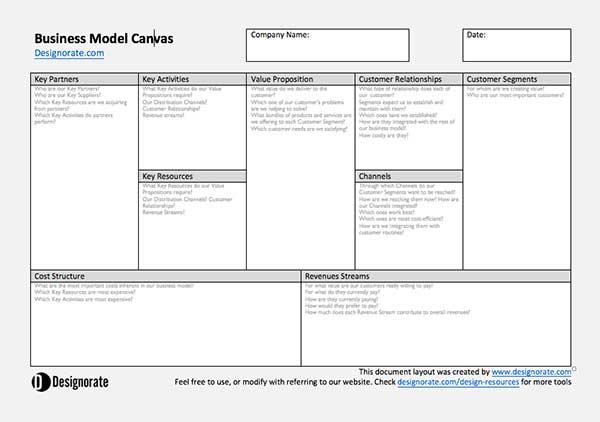
The business model canvas was proposed by Alexander Osterwalder in his book, Business Model Ontology, and it presents the elements that form the building blocks of a business plan for a new or existing business. It is a simple template with nine cells. Each cell includes one of the business’s essential components; customer segments, value propositions, channels, customer relationships, revenue streams, key activities, key resources, key partnerships, and cost structure.
Business Model Canvas Elements
Unlike the written business plan, the business model canvas allows you to clearly project all the business factors and answer question related to the above elements as follows.
Customer Segments
This part describes your consumer by answering questions such as who are your consumers? What do they think, feel, see, or do? This part allows you to learn if the business targets one or multiple market segments, the persona for each segment, and the service provided for consumers. The expected output is a persona for each consumer segment.
Value Propositions
What is the value delivered to the consumer? Which consumer’s problem does the product target? How do we satisfy our consumers? After setting up the persona based on the customer segment section, this part focuses on the value provided for each segment and improves the competitive position of the product or service. These facts help us to build a priority list of the value propositions and link it with the consumer personas.
Channels
Where will the product be sold or promoted? Why choose these channels, and why are they efficient? This part focuses on where communication between the business segments and value propositions takes place. For example, a kitchen product that solves a heating problem while cooking (value proposition) can be purchased by housewives (target segment) through their online store, Amazon, and local distributors (marketing channels).
Customer Relationships
How does the company interact with its consumers? How does the company manage this relation between the product or service and costumers? In this part, you determine how you plan to communicate with the consumer during or after the product’s sale. This leads to questions regarding the best method to communicate with consumers in order to deliver the value proposition.
Revenue Streams
Where will the revenue come from? This part links the segment, proposition, and channel elements. For example, revenues (a) will come from segment (b) by providing proposition (c), through channel (d). In the previous example, the revenues will come from selling the kitchen product to housewives through Amazon.
Key Activities
What are the activities required to deliver the value proposition, distribute the products through channels, build a customer relation, or have a revenue stream? This section includes working with partners, improving the product, or collecting feedback from consumers. All the activities related to delivering the value proposition should be included in this section.
Key Resources
What resources should be present in order to deliver the value proposition and compete in the market? This also includes the resources involved in other aspects, such as customer relations, distribution channels, and achieving the revenue stream. The resources vary from one product to another based on the nature of the production process. It can be infrastructure, human resources… etc.
Key Partnerships
Who are the business partners and suppliers involved in the sales process? Those partners may be involved in delivering the value proposition to consumers by acting as a sales channel or customer support agents.
Cost Structure
What is the business model cost? Which elements are the most expensive? This section includes both direct and indirect costs involved in the business model. It should describe the cost of each of the above elements.
Download Our Business Model Canvas
The business model canvas is a simple table that can be downloaded quickly, filled out, and discussed by the business stockholders. Our Business Model Canvas can be downloaded from the link below.
Download Now
This PDF document can be downloaded, filled out, and printed or shared through email with your team. Also, there are other tools that can help you to build a business model canvas such as the Strategyzer online tool and iPad application.



Leave a Reply