
The design process involves multiple disciplines starting from the emphasize phase to the final product delivery. However, achieving a desirable design experience extends the borders of the product development to include the service design. Unlike the physical product design, the service design focuses on the communication between consumers and the organization during the process of buying or using a physical product or service.
Service Design is a co-created experience that includes the consumer and the organization employees or infrastructure through touch points, these are the points where the consumer needs to interact with the service such as the employees, the purchase place, the infrastructure used to create the service, and the business partners involved in the process.
It’s not just what it looks like and feels like. Design is how it works.” — Steve Jobs
Also read:
- 7 Steps to Create a Successful Journey Map
- Using Persona Empathy Mapping to Understand User Behavior
- Persona vs. Archetype: Which Is Better For Design Brainstorming?
The Service Design Thinking Process
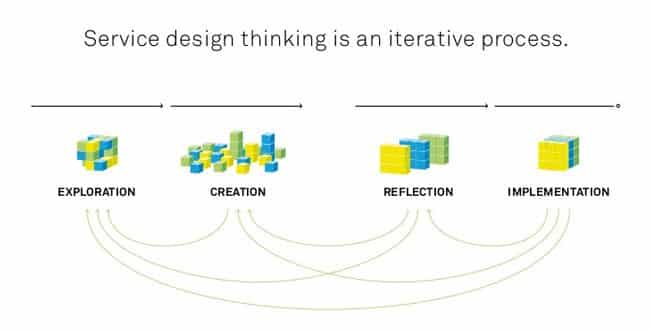
Every product is different and has a unique service experience in terms of the type of the product, the service provided, and the persona of the consumer involved in the process. Therefore, a service design thinking process is required to ensure designing a tailored experience for each consumer segment. For example, the service design for car selling may vary from one type of cars to another based on the market segment, the luxury car may require a different service model compared with selling an economy car. The service design thinking process is an iterative process involves four stages: exploration, creation, reflection and implementation. These stages are very similar to the phases described in other design thinking models such as the Stanford School’s design thinking process and the IDEO design thinking process.
Stage 1: Exploration
In order to build a consumer-centered service, every design process starts with research that aims to understand more about the consumer such as:
- What is the consumer characteristics and culture?
- What is the consumer experience before, during and after purchasing the product or service?
- What is the existing problems that face the consumer at each touch point?
In order to answer these questions, designers start by building a journey map that provides a track path for the user in retail and explores the pains faced during this experience. Further investigation may include qualitative and quantitative research; the qualitative research aims to understand the consumer feelings and experience and can be done through interviews and focus groups. The quantitative research attempts to understand the facts and measurable information such as the quality of service and it includes methods such as surveys.
In many cases, the discovered problems are the effect of multiple causes. In this case, a tool, such as the cause-effect diagram, can help identify the real causes behind consumer problems.
Stage 2: Creation
As the service design is based on the co-creation model, this stage involves the collaboration of all stakeholders to plan the service design that will be delivered to the consumer. The consumer can be represented in this stage by a sample consumer base to discuss ideas with the company team. The main aim of this stage is to formulate the Exploration stage results into an action plan. This stage is very similar to the ideation phase.
Stage 3: Reflection
This stage can also be called the “prototype” in the other design thinking models. This allows the team to build a prototype that is supposed to improve the consumer experience. It helps to convert the theoretical research results into a tangible solution that can be evaluated and modified in further stages. These steps also save time and costs as the company doesn’t need to wait for the whole service design experience to be built in order to test it.
The reflection stage is at the heart of the iteration process, if the prototype requires further Exploration or Creation, then the process is returned to the first or the second stage again before building another prototype based on new research results.
Stage4: Implementation
After applying all the feedback to the prototype and reach a satisfactory stage, the final service is designed and implemented in the system. By this stage, the solution can be tested in its realistic state. The implementation of the changes in the system should consider the consumer review for this provided service. The collected feedback from consumers can help in the iterative process when improvements are needed again in the future.
How to Build a Successful Service Design Thinking
While designing the service following the above stages, it is critical to consider the design principles required to achieve a successful consumer service experience. The service design thinking process should consider the below principles in order to archive its target successfully:
Inclusive design, it includes the consumer at the heart of the process by involving consumers in the different stages of the service design process.
Understand consumer, the research phase should only focus on understanding the consumer, the problems that need solutions, and the needs of the population.
Consider empathy, the service design aims further than just addressing the current problems, but also focus on the unexpected needs that can make the consumer experience pleasant. This requires the designers to practice the journey map themselves in order to live the consumer experience.
Add brand value, similar to the product, the service should reflect the brand value associated with it. This involves how the employees, infrastructure and system communicate with the consumer,
The service design thinking process is iterative, tailored and aims to provide a unique experience for the consumer. This can be only achieved by applying a design thinking process. This process is very similar to the design thinking models, although the names of the stages may be different. In order to reach the desired target from the process, the designers should consider design principles such as building inclusive design, depending on research, building empathic relationships between the consumer and service, and reflecting the company brand in the provided service.
The iteration of the service design ensures it is in a continuous improvement and development process to reach a higher consumer stratification, which will reflect positively on the company’s competitiveness in both market and business success.





Leave a Reply