
Starbursting brainstorming is another creative tool that takes a different approach from other techniques. When the team within the organisation brainstorms new ideas using mind-mapping and brainstorming tools, the focus is on generating ideas and accepting all ideas. This approach aims to expand the problem exploration in an early stage of the design thinking process. This exploratory stage is divergent, allowing the team to explore the problem frame. After a clear definition of the problem, the team moves forward to explore the different solutions (i.e. prototypes). Download the Starbursting technique template by clicking the download link at the end of the article.
Related articles:
This stage, again, is divergent. The team presents other solutions and tests them to reach the final solution or product. Based on the nature of the process, the team's main aim is to find answers to questions or problems. These answers need further exploration throughout the process of finding solutions, which is applied using the Starbursting technique.
What is the Starbursting Brainstorming?
Every project starts with idea development. The biggest challenge is understanding all the project-related factors and asking the right questions to evaluate the new idea. Different brainstorming tools are used to explore solutions and new ideas. The Starbursting tool explores solutions by asking questions about them. It is similar to the Reverse Brainstorming tool.
The Starbursting technique is a systematic method for asking questions that explore the different dimensions of new ideas and their viability. For example, what is the target market segment? How will we sell the product? And when is the appropriate launch date?
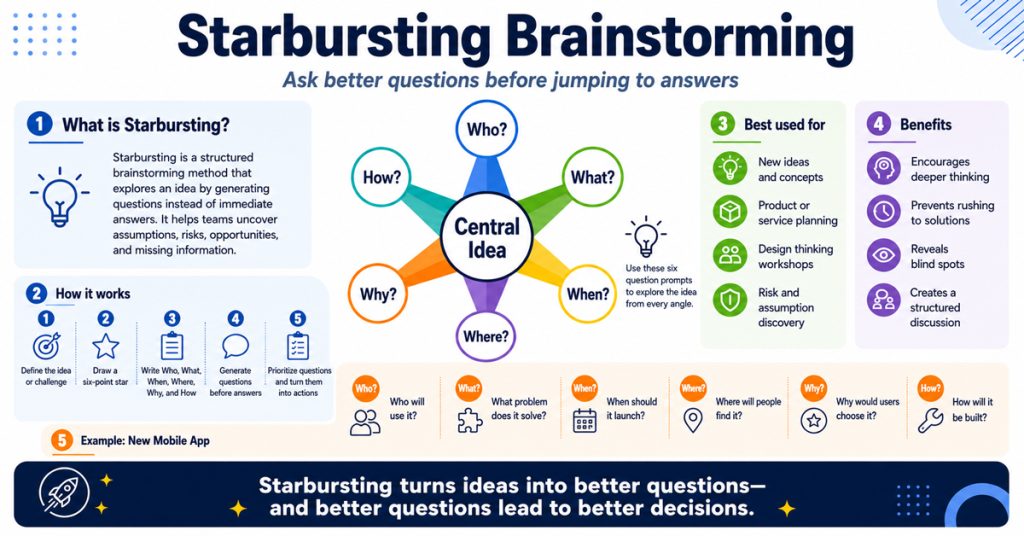
Starbursting is based on six main question groups arranged in a star shape. These groups are tagged by Who? What? When? Where? Why? And How? Each question group is discussed during the team meeting, and some questions are assigned to each group. Sometimes, it is also called 5W1H because of the type of questions we ask during the brainstorming session.
A clear vision about the project or the new idea can be ascertained by answering the given questions. To ensure the successful implementation of the starbursting method, the facilitator should consider the following:
- A systematic flow of questions in a specific order
- The questions are relevant to the topic or idea.
- All the related questions to the project or concept should be covered.
- All the questions should be answered.
Sratbursting brainstorming is a way to organise ideas during the brainstorming meetings. We previously explored similar tools, such as the Six Thinking Hats, SCAMPER, 5 Whys, and Paul Elder's critical thinking.
| Method | Main purpose | Best used when | Core question/focus | Output | Strength | Limitation |
| Starbursting | Explore an idea by generating questions before answers | You have a new idea, product, service, or concept that needs evaluation | Who, What, When, Where, Why, and How? | A structured list of questions, assumptions, risks, and next actions | Helps teams avoid jumping too quickly into solutions | Can produce too many questions unless they are prioritised |
| Six Thinking Hats | Look at a problem from multiple thinking perspectives | A team needs balanced discussion, decision-making, or idea evaluation | What happens if we separate facts, emotions, risks, benefits, creativity, and process? | A more balanced view of an idea or decision | Reduces conflict by giving people shared thinking roles | Can feel artificial if participants do not understand the hats |
| SCAMPER | Improve or generate ideas by modifying an existing product, service, or process | You already have an idea and want to develop alternatives or improvements | Can we Substitute, Combine, Adapt, Modify, Put to another use, Eliminate, or Reverse it? | New variations, improvements, or innovation directions | Very practical for product/service innovation | Works best with an existing idea, not a blank page |
| 5 Whys | Find the root cause of a problem | A clear problem, failure, or issue needs investigation | Why did this happen?repeated several times | A root-cause explanation and possible corrective action | Simple and fast for problem diagnosis | Can oversimplify complex problems with multiple causes |
| Paul-Elder Critical Thinking Framework | Analyse the quality, logic, and depth of thinking | You need rigorous evaluation of an argument, decision, research question, or strategy | What is the purpose, question, evidence, assumptions, implications, and point of view? | A structured critical analysis of reasoning | Strong for academic, strategic, and evidence-based evaluation | More complex and slower than quick brainstorming tools |
How to Apply the Starbursting Technique
The steps below guide the team in applying the starbursting method. For personal or individual thinking, the designer can simply follow the stems below. For company teams, the discussion facilitator should guide the rest of the discussion members through it.
Step 1
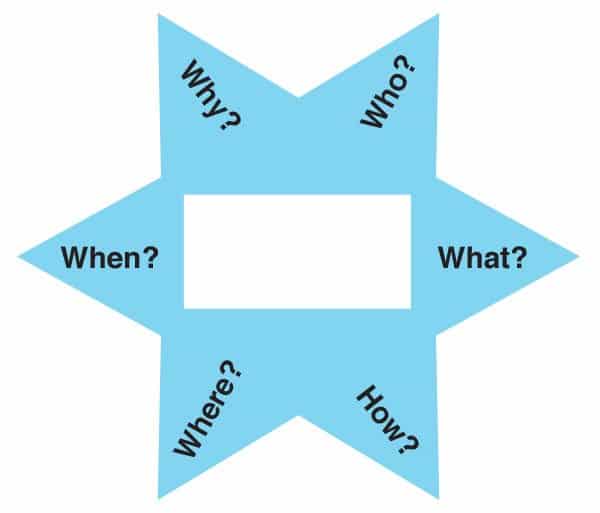
Use a large sheet of paper to draw a six-point star. You can also download our Starbursting Template at the end of the article and print it. In the middle of the star, write down your idea or project name.
For example, the company would like to create a new mobile application for its online store. Write down in the centre of the paper, the word "Mobile application."
Step 2
At each point of the star, write one of the main question groups: Who? What? When? Where? Why? And How? These groups will be discussed systematically with your team.
Step 3
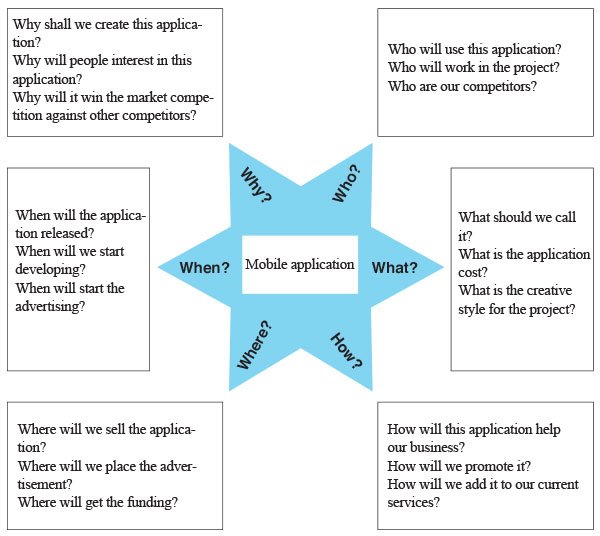
Start brainstorming each type of question and write them down on their respective star points. At this stage, focus on writing down the question without answering it. In the mobile application project, the questions can be presented in the figure below.
Who:
- Who will use this application?
- Who will work on the project?
- Who are our competitors?
What:
- What should we call it?
- What does the application cost?
- What is the creative style for the project?
How:
- How will this application help our business?
- How will we promote it?
- How will we add it to our current services?
Where:
- Where will we sell the application?
- Where will we place the advertisement?
- Where will we get the funding?
When:
- When will the application release?
- When will we start developing?
- When will the advertising start?
Why
- Why shall we create this application?
- Why will people be interested in this application?
- Why will it win the market competition against other competitors?
Step 4
At this stage, the team discusses the answers to each question. The collected responses help build a clear vision of the product or idea. If there are many questions, further sessions can be held to explore all the answers.
Pros and Cons of the Starbursting Method
The starbursting method tends to provide a focused, systematic, and comprehensive flow of guided thought, structured around specific steps and questions. This advantage promotes a methodology for critical project time, dedicating a short period to brainstorming new ideas. Unlike other brainstorming methods, such as mind maps and Bono'sSix Thinking Hats, starbursting should take less time to achieve the targeted results. All the general criteria are set in place beforehand.
On the other hand, most of the steps discussed in starbursting focus on finding the questions rather than answering them. It does not guide how to answer the questions in the same systematic way of collecting the questions. This disadvantage can affect the significance of the results, especially when the answers go in the wrong direction, such as providing false answers, giving biased responses, or building results based on these answers.
Download Designorate Starbursting brainstorming template.
Conclusion
The starbursting method is one of the systematic brainstorming tools used to evaluate ideas and projects by asking the right questions. These answers should provide comprehensive coverage for the project's success and failure factors.
The starbursting method operates in steps that guide the team through several question groups. The Starbursting Template can be downloaded from the link below and used during the brainstorming session.
The main goal of Starbursting brainstorming is to ask questions rather than find answers. This concept is different from other brainstorming tools. While this approach offers an advantage, its implementation requires a clear understanding of this aspect.





I really like your starburst favorite and your starburst of pink I just have a suggestion the pink ones just have strawberry well… Watermelon is pink too so shouldn’t that be in the package of all pink? It would really be nice if this was taken into consideration