
Summary: During brainstorming and discussions, some thoughts bubble up while others are buried. De Bono's Six Thinking Hats technique provides a systematic solution to sharing and improving ideas by eliminating idea-destructive elements during brainstorming meetings.
The Six Thinking Hats technique is a critical thinking method developed by Edward de Bono to enable the brainstorming team to investigate problems or ideas from six perspectives: facts, emotions, benefits, risks, creativity, and process control. Each perspective is represented by a coloured hat, which allows the team to stay focused and think in an organised way, focusing on one perspective at a time for more efficient session outcomes.
Our thinking can be unstructured and reinforced, leading individuals and groups to think irrationally and be biased toward specific ideas, which affects the outcome of the design thinking process. The six thinking hats technique introduced a structured approach to discussing topics rather than a chaotic one. While the six thinking hats method does not follow the ordinary way of thinking, it can be used during a specific critical thinking session to achieve targets such as solving problems, discussing arguments, conducting in-depth analysis for planning, and running the creative thinking process. In this article, we will explore the Six Thinking Hats technique, its advantages, and how to apply it. You can download the Six Thinking Hats PowerPoint template to use as a meeting agenda.
What Is the Six Thinking Hats Technique?
In his book Lateral Thinking for Management, De Bono introduced a directional sequence for the brainstorming process. The Six Hats thinking method is based on a metaphorical six hats representing different thinking types. The team uses these hats to address situations in a sequenced, rather than chaotic, manner. Six Hats thinking can be used during critical thinking sessions to achieve specific targets, such as solving problems, discussing arguments, planning in depth, and analysing the creative thinking process. It is very similar to other techniques, such as the Paul-Elder Framework and the SCAMPER technique.
The method has been introduced to help companies improve return on investment (ROI). When adopting the method with business students, their business models were more coherent and comprehensive than in the ordinary meeting discussions. It can also be successfully applied to school students through the thinking-in-education approach. Over the last four years, I've adopted the Six Thinking Hats while teaching the design process to my master 's-level students to organise their thoughts while designing their brand business. I will use this example later when we cover the tool's practical application. If used during the Double Diamond design thinking process, it can improve outcomes in the exploration and development stages.
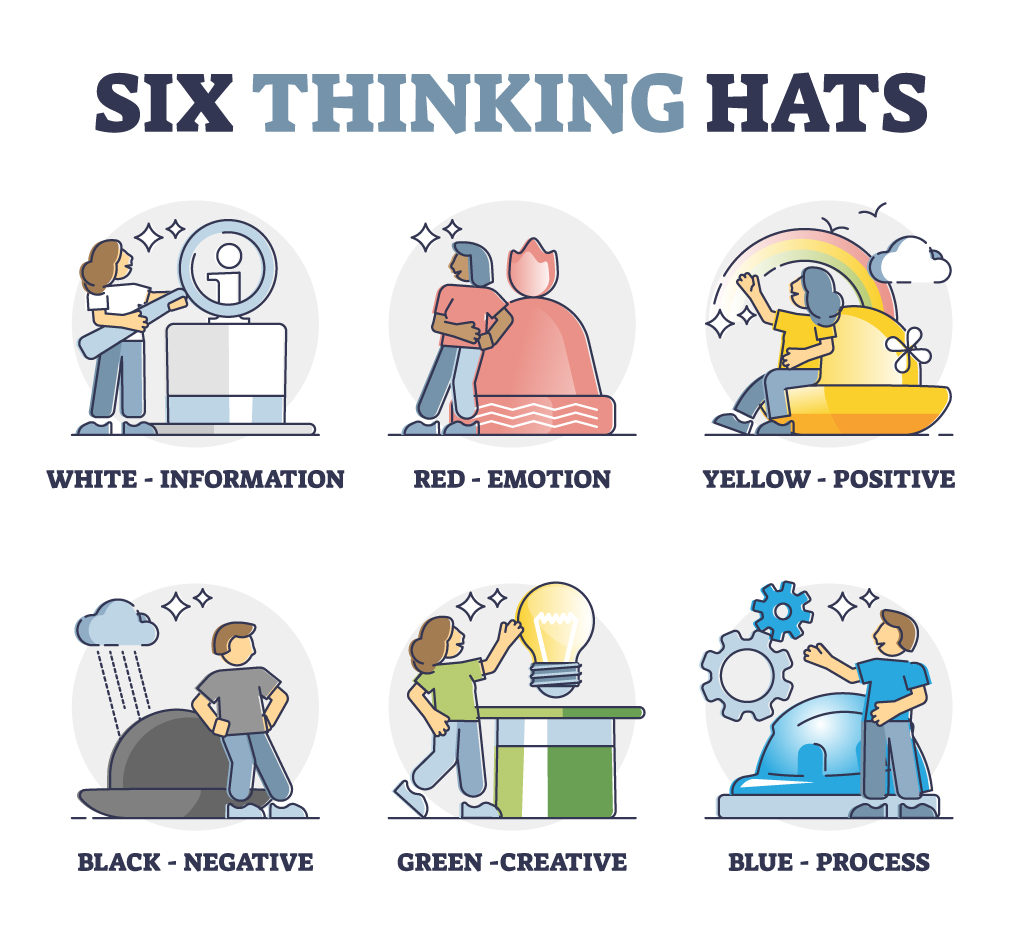
De Bono Six Thinking Hats
Solving problems using the De Bono Six Thinking Hats technique requires considering different perspectives. Each perspective is represented with a hat colour. At the end of the discussion session, stakeholders should better understand the problem through alternative approaches, enabling them to develop creative, innovative solutions. During each critical thinking discussion meeting, the facilitator determines which hat should be worn in a specific part of the discussion as follows:
| Hat | Thinking mode | Main question |
|---|---|---|
| White hat | Facts and information | What do we know? |
| Red hat | Feelings and intuition | What do we feel? |
| Black hat | Risks and cautions | What could go wrong? |
| Yellow hat | Benefits and value | What are the advantages? |
| Green hat | Creativity and alternatives | What new ideas are possible? |
| Blue hat | Process and facilitation | What is the next step? |
White hat
This hat represents the facts and information about the problem of the argument. During this part, the stakeholders only share information about the issue and take notes. No further development in the thinking process should be done. Questions in this part can be "what is the available information?" and "what are the facts we have?"
Yellow hat
In contrast to the black hat, the yellow hat is supposed to reflect the sun or an optimistic attitude. The stakeholders view the problem or suggestion from an optimistic perspective. It helps to spotlight the advantages and benefits of the recommendations. During this, the questions are: "What are the advantages of applying the solution?" and "Why do you think it is workable?"
Black hat
Wearing the black hat drives attendees to think about the problem or suggestion cautiously and defensively. This part aims to identify the proposal's disadvantages and explain why the idea may not work, using logical reasons.
Focusing on the warnings, risks, or cautions helps stakeholders isolate the reasoning and think of solutions in the yellow one. During this discussion, the question that can be asked is "What are the risks?" and "Why is the suggestion not working?"
Red hat
The emotions that present the stakeholders' feelings about the problem and their gut reactions. Using this hat helps understand different emotional responses, such as love, hate, like, and dislike. The red hat does not aim to understand the reason behind these feelings. We can ask questions like "What do you feel about the suggestion?" and "What is your gut reaction?"
Green hat
This hat represents the creative thinking part of the discussion. During the critical thinking discussion, this hat helps stakeholders develop creative solutions to problems or consider suggestions from a creative perspective. Innovative tools can drive creativity during the conversations, such as Lego Serious Play and brainstorming techniques.
Blue hat
This hat is the process control plan where the meeting leaders manage difficulties during the discussions. It ensures that the Six Thinking Hats guidelines are applied. This hat can be used to drive the thinking process to better routes. For example, the facilitators can direct the discussion to the green hat route if there are no ideas.
I believe the hat sequence and which set of hats to use during the commenting or evaluation session are not fixed; they are determined by the project type, the team, and the session's aim. Figure 2 below shows the six thinking hat scenarios and how the hat order changes depending on the main aim of the discussion.
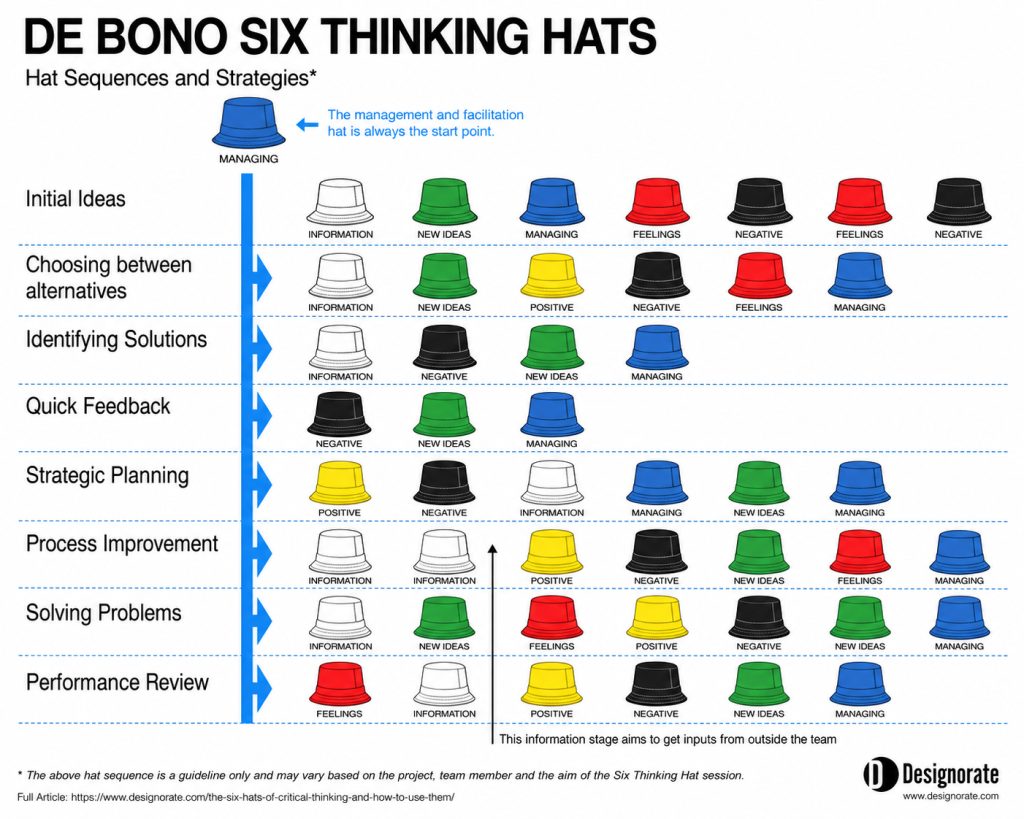
This ability to flexibly reorder the thinking sequence provides an extended opportunity to utilise the six thinking hats technique across different scenarios.
Advantages of the Six Thinking Hats Technique
Parallel thinking over debate: In traditional meetings, debate and argument hinder rational thinking and cause ideas to be missed as the discussion shifts from one point to another. The hats get everyone thinking in the same direction at the same time.
Distance people from ideas: As the hats are role-play, they distance people from an opinion position, and the sessions provide a safe space to share ideas without risking judgment or confrontation.
Makes all types of thinking legitimate: In many professional and social cultures, some types of thinking are not encouraged. For example, in some business cultures, emotional responses (red hat) or optimistic speculation (yellow hat) are not encouraged, leading to missing opportunities. The six thinking hats give every mode of thinking its own protected time and space.
Saves time: One key problem with brainstorming techniques (such as reversed brainstorming) is that they can be a waste of time when people start talking without a clear direction. With this organised structure, teams often cover more ground in 60 structured minutes than in three hours of open debate.
Reduces dominance by strong personalities: When everyone must respond through the same hat at the same time, louder or more senior voices can't monopolise the session.
Improves decision quality: Because the technique forces the group to systematically cover optimism, risk, data, creativity, and process, decisions are less likely to have blind spots.
Works across cultures and disciplines: The coloured-hat metaphor is intuitive and language-neutral, making it suitable for multicultural teams and diverse professional backgrounds.
Adaptable in scale and format: The technique works equally well as a full-team exercise, a solo thinking tool. So, it is a perfect tool for designers to brainstorm and evaluate ideas.
Example of Applying the Six Thinking Hats Technique
The Six Thinking Hats technique has many applications for exploring and evaluating ideas. So, let us explore a practical example of using the six thinking hats technique to design a social media excess usage app for young adults to break the habit formed by the so-called UX dark patterns. So, the session time will be around 64 minutes, and the participants will be the product team, UX researchers, and an optional young-adult users sample.
White Hat
Time: 10 minutes

What is the average daily social media use among young adults?
Which are the most used social media platforms?
What does peer-reviewed research say about the negative impact of excess usage?
How many young adults report wanting to cut down but feeling unable to?
How do you feel when you realise you’ve spent two hours scrolling without meaning to?
Does the idea of an app limiting your social media feel intrusive, helpful, or something else?
What emotions do young adults associate with putting down their phones?
How does the team feel about building a product that restricts behaviour?
What is the emotional reaction when a screen-time warning pops up?
What emotional response does the app’s name or branding trigger?
Red Hat
Time: 7 minutes

Black Hat
Time: 12 minutes

Why would a young adult download and keep an app that restricts the very things they enjoy?
Could the app feel patronising or controlling, leading to an immediate uninstall?
What stops users from bypassing limits — deleting the app, switching to a browser, using a second phone?
Are there privacy risks in tracking usage data, and how might that erode trust with a privacy-aware generation?
What does a healthier relationship with social media look like in six months?
Which features are most likely to create a genuine “aha” moment that earns long-term retention?
What competitive advantage could this app have over built-in platform tools that most users quietly ignore?
How could this become socially viral — something users recommend to friends rather than keep quiet about?
Yellow Hat
Time: 10 minutes

Green Hat
Time: 15 minutes

What if the app replaced scroll time with a one-minute real-world micro-challenge — walk outside, call a friend, make a coffee?
Could peer accountability — voluntarily sharing your usage stats with a trusted group — act as a social motivator?
What if instead of blocking, the app introduced a mandatory 10-second breath pause before opening any social platform?
Could an AI generate a personalised weekly “reflection letter” describing the real experiences you missed while scrolling?
Which facts from the white hat session are most important to consider?
Which emotional tensions from the red hat must UX design resolve?
Which yellow-hat benefit is the clearest, most compelling value proposition for the app-store listing?
Which three green-hat ideas are worth prototyping in the next sprint — and who owns each one?
What does success look like at 30 days, 90 days, and 12 months, and how will it be measured?
Blue Hat
Time: 10 minutes

The table below provides a summary of the activities across all six thinking hats:
| Session stage | Hat | Time | Purpose | Example questions |
|---|---|---|---|---|
| 1 | Blue | 5 min | Define goal and process | What decision are we making? |
| 2 | White | 10 min | Gather facts | What data do we have? |
| 3 | Red | 7 min | Capture reactions | What do users feel? |
| 4 | Black | 12 min | Identify risks | What could fail? |
| 5 | Yellow | 10 min | Identify value | What benefits are likely? |
| 6 | Green | 15 min | Generate ideas | What alternatives can we test? |
| 7 | Blue | 5 min | Decide actions | Who owns each next step? |
Tips to Run a Successful Six Thinking Hats Session
As with any brainstorming technique, running a successful Six Thinking Hats session requires careful preparation, disciplined facilitation, and a commitment to "parallel thinking," in which all participants focus on the same perspective simultaneously; otherwise, the meeting will not achieve the intended outcome (check 8D Problem Solving, TRIZ technique).
Preparation and Setup
- Participants should understand the Six Thinking Hats technique and how the session will run through a clear orientation.
- Clearly state whether the goal is to solve a specific problem, make a decision, or generate new ideas, as this determines the most effective hat sequence as highlighted above.
- Participants must be informed of the time blocks of each hat to maintain momentum.
Effective Facilitation
- The facilitator (Blue Hat) must ensure the participants stay "on-hat". For example, if someone makes a critical remark during the Green (creative) or Yellow (positive) phase, they should be gently redirected to save that thought for the Black Hat phase.
- Manage Participation: Ensure each meeting member has a voice and that no single voice dominates the conversation under each hat.
- Use Visual Indicators: Use visual cues such as coloured cards, presentation slides, or physical hats to remind everyone which thinking mode is currently active.
- Stay neutral: The facilitator should remain neutral and avoid contributing their own opinions while managing the process, and only share their perspective when they explicitly announce they are wearing a different hat.
Capture and Action Record Contributions
- Use the final Blue Hat session to synthesise the findings, summarise conclusions, and define clear next steps or action items.
How to Run Six Thinking Hats Online?
Online brainstorming can be an effective solution to overcome the time, location, and logistical constraints of conducting the Six Thinking Hats technique in person. Thankfully, there are several online Six Thinking Hats templates you can utilise during your online meeting:
- Creately Six Thinking Hats template
- Miro Six Thinking Hats Template
- Figma Six Thinking Hats Critique Template
- Mural Brainwriting template
Six Thinking Hats Template
Download Designorate Six Thinking Hats template and meeting facilitation deck to help you run effective session. The template is available in PDF and PPT formats.
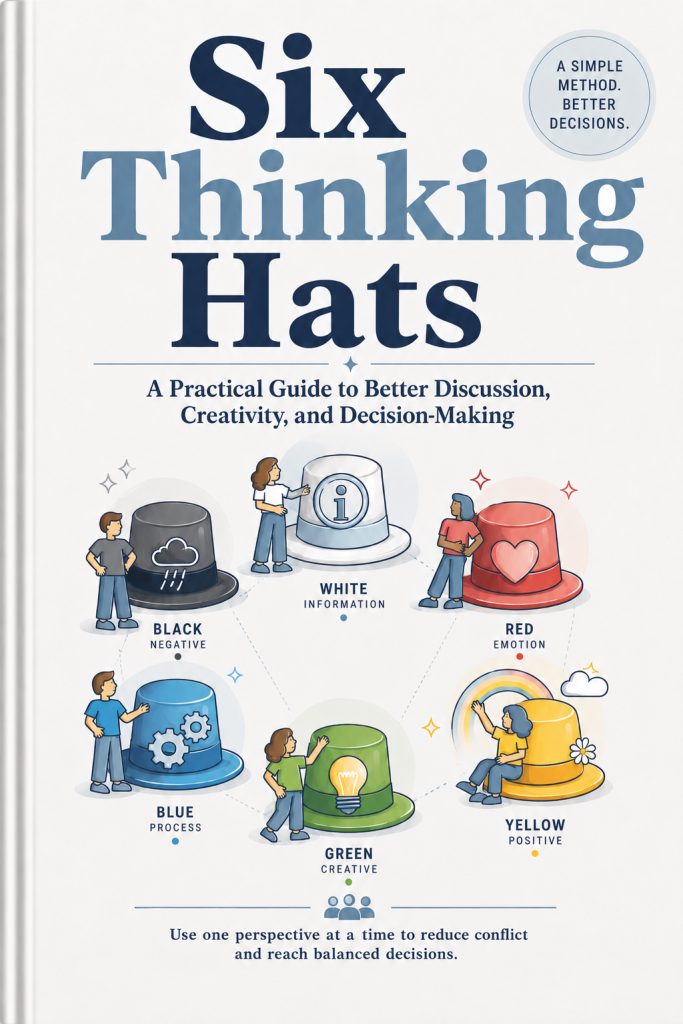
The Six Thinking Hats method provides a parallel thinking model to get the most out of critical thinking discussions. By organising their thinking using the metaphor of the six hats, stakeholders can ensure the topic is covered from multiple perspectives. This organised thinking approach occurs quickly during the discussion to reach the best possible output of the design thinking process. While the six thinking hats technique is discussed separately from the design thinking process, both work closely toward building creative solutions and innovative approaches.
Bibliography
- De Bono, E. (2017). Six Thinking Hats: The multi-million bestselling guide to running better meetings and making faster decisions. Penguin UK.
- Kivunja, C. (2015). Using de Bono’s six thinking hats model to teach critical thinking and problem-solving skills essential for success in the 21st-century economy. Creative Education, 6(03), 380.
- Göçmen, Ö., & Coşkun, H. (2019). The effects of the six thinking hats and speed on creativity in brainstorming. Thinking Skills and Creativity, 31, 284-295.
Note: This article was first published in January 2015 and updated in May 2022.





This is very helpful, I definitely will include it in my Professional communications assignment but i need the publication date of this article.
It is helpful. The idea is brilliant. It could be applied individually or within a group to have a cohesive methodical brainstorming.
Dear Rana, thanks and glad you find the method useful. I use it with my students all the time. Thanks! Rafiq
This is so fantastic and may you continue to create such powerful content
Thanks!