
Summary: Disney Creative Strategy is a creative thinking method. It separates the teams' thinking process into three roles: The Dreamer, the Realistic, and the Critic. It helps ideas to be imagined, planned, and improved.
Recently, I introduced you to a number of methods and tools to fuel innovation and creativity within organisations through creative thinking and brainstorming, such as Lego Serious Play, De Bono's Six Thinking Hats, and Reversed Brainstorming. Disney’s Creative Strategy is another tool for creative thinking, inspired by Walt Disney.
He was talented in discovering creative ideas and converting them into reality. Based on a close associate, he used to say, “There were actually three different Walts: the dreamer, the realist, and the spoiler. You never knew which one was coming to the meeting.”
What is Disney’s Creative Strategy?
Walt Disney’s strategy was later highlighted and modelled by NLP expert Robert Dilts in 1994. He defined the technique as Disney’s method for turning his dream into reality. In this method, a group of people use a specific thinking flow that builds parallel thinking, which can be used to generate, evaluate, critique, and solve ideas and problems. It is very similar to tools such as the Six Thinking Hats and the SCAMPER technique.
Although Walt Disney did not fully develop the method, it bridges the gap between imagination and reality. The creative process unlocks the mind’s capacity to dream and generate unexpected ideas and solutions to existing problems. However, these solutions may not be applicable in practice or serve as a strategic plan. Therefore, one of the advantages of Disney's creative strategy is its ability to balance dream and reality to build a viable layout.
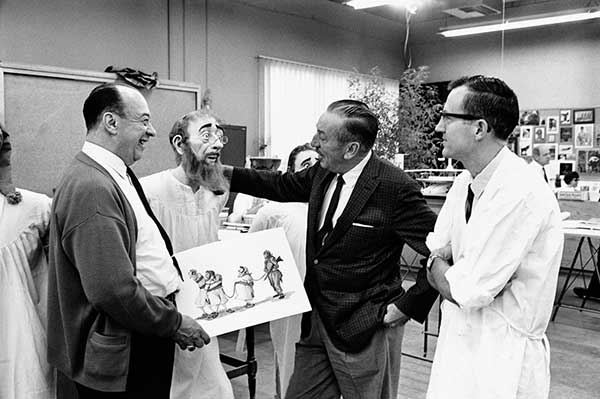
Robert Dilts describes Disney’s ability to explore creativity:
"Walt Disney's ability to connect his innovative creativity with successful business strategy and popular appeal certainly qualifies him as a genius in the field of entertainment. In a way, Disney's chosen medium of expression, the animated film, characterises the fundamental process of all genius: the ability to take something that exists in the imagination only and forge it into a physical existence that directly influences the experience of others in a positive way.”
How to Conduct Disney's Creative Strategy?
To prepare the team for Disney’s Creative Strategy, four parts of the room are set for each thinking method. The first part is for dreaming and imagination; the second part is for realists and/or planning; the third part is for critics; and the fourth part is for getting the mind outside the thinking flow.
The idea of setting a thinking place for each stage of the method is to prepare the team's mind to switch between thinking modes. The place can be a room, an open office space, or an outdoor garden.
The team gathers around a target to achieve; this target can be a dream to turn into reality, a design to visualise, a problem to solve, or a process to improve. However, Disney's history of methods makes it a good fit for creative brainstorming to help turn dreams into actionable projects.
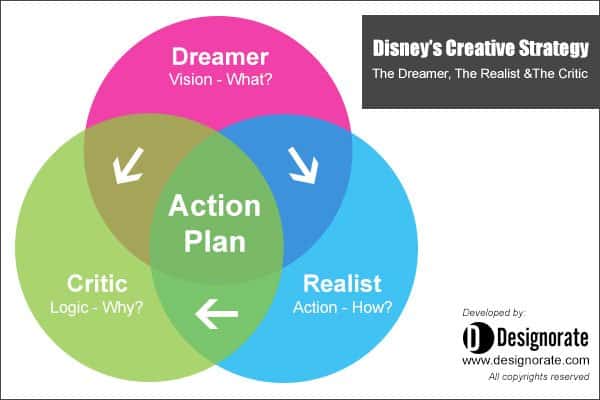
Disney's Creative Strategy Stages
The strategy is based on three main stages: the dreamer, the realist and the critic. Each stage represents a style of thinking, and it should be applied in the same sequence as follows:
The dreamer
Usually, any creative idea starts with a dream full of passion and enthusiasm. In ordinary meetings, this dreaming style is halted by reality and does not have the space to go further. Discussed in detail in this Disney Creative Strategy, the first stage allows the team to share their dream without restrictions or criticism. This helps to build a pool of creative ideas. Some of these ideas are viable, and others are not. Determining the viable creative concepts comes later as a result of the second and third thinking styles.
The dreamer asked questions that help describe ideas and thoughts, such as the following:
- What do we want?
- What is the solution?
- How do we imagine the solution?
- What are the benefits of applying this solution?
The realist
Subsequently, the realist style follows. The team switches the location and mode to adopt a more logical planning style. Based on the first stage, the attendees pretend that the dream is possible and begin making plans to achieve it. The plan aims to turn the imaginary ideas into a manageable action plan. During this stage, all thoughts should be constructive and aimed at turning the idea into a real plan. This stage includes questions such as the following:
- How can we apply this idea in reality?
- What is the action plan to apply the idea?
- What is the timeline to apply this idea?
- How to evaluate the idea?
The Critic
With an action plan to turn the idea into reality, the critical thinking mode tends to identify the barriers to implementing it and how to overcome them. In this session, the team provides a constructive critique of the idea to identify weak points and address them in the final solution. In this stage, the team asks questions as follows:
- What could be wrong with the idea?
- What is missing?
- Why can't we apply it?
- What are the weaknesses in the plan?
How to Conduct Disney Creative Strategy online?
Although in-person creative sessions can be more effective than online ones, online participatory workshops can be more convenient and flexible, especially when it is hard for the team to be in the same place at the same time. There are several Disney Creative Strategy templates that you can use as a starting point, such as:
Conclusion
As a result of the three main stages outlined above in Disney’s Creative Strategy, the team develops a solid creative idea with an action plan to implement it. The first stage focused on the creative aspect, with ideas and solutions shared. The second stage focused on reality and how to turn the idea into an action plan, and finally, the third stage aims to identify the weaknesses in the idea and overcome them in the final plan.
While other creative thinking methods, such as Six Thinking Hats, do not prescribe a specific sequence of steps, Disney’s Creative Strategy requires following the steps as stated above.
Bibliography
Simonton, D. K. (2009). Genius 101. Springer Publishing Company.
Amirnudin, M. T. M., & Saleh, S. (2020). Effectiveness of Disney's NLP-Based Strategy to Improve Students' Higher-Order Thinking Skills. International Journal of Instruction, 13(3), 293-306.
Grinder, John, and Richard Bandler. "The structure of magic: II." (1976).
De Bono, E. (2017). Six Thinking Hats: The multi-million bestselling guide to running better meetings and making faster decisions. Penguin UK.




You mention the fourth part of the room is for getting the mind outside the thinking flow. Can you provide more detail on this fourth part and questions to ask?
Hi Sarah, I am sorry for the late reply. The fourth side of the room represents the final conclusion to be addressed. The attendees don't use the method flow anymore as they go through the three steps. At this part, attendees make a decision about their ideas based on the previous steps.
I found this article very interesting. I teach new business owners and have learned some interesting creative processes to teach from this article.
Thanks!