
Over the course of understanding the challenges that face design industry in the Middle East and North Africa, we established the Design MENA section where we try to address the issues related to design in this area of the world. According to a previous study that I wrote for the Design Management Review, Barriers Facing Design, and Creativity in the Middle East SMEs, the majority of the responses pinpointed the design education as one of the major challenges that face companies working in the design field in the region.
The design education in the MENA region presents a noticeable barrier for designers to acquire the matrix of knowledge that is required from designers inside the organizations. According to the study, design schools plays an efficient role in this problem due to the problems that face these schools including the low number of design schools, high tuition costs, or the lack of addressing the knowledge required for the creative market needs.
Related articles:
- Why Design Education in the Middle East Doesn’t Meet the Market Needs
- Design Drivers in the Middle East
- Taking the “Designed in Lebanon” Model into Action
- What Designers Need to Learn Aside from Their Design Education
In this survey, we asked a sample of designers who work in the MENA about their design education background and their impressions about the design schools in the area of the world in order to understand the following questions:
- What is the education background for the majority of designers in the MENA area?
- How do they learn the design knowledge required for their career?
- What do they think about the design schools in the MENA?
The demographic Information and Professional Background
The designers presented a sample from different countries majority of them are from Egypt, Jordan, and Lebanon. The rest of participants are coming from Saudi Arabia, Libya, Morocco, Palestine, Syrian Arab Republic, and Pakistan. The career experience varies from 0 to more 20+ years pf experience. The majority of the responses are 5-10 years experience, 0-2 years experience , and 10-20 years experience. The majority of the respondents work in the graphic design field, while others work in different design fields such as the web and mobile app design, advertising, architecture , animation and others.
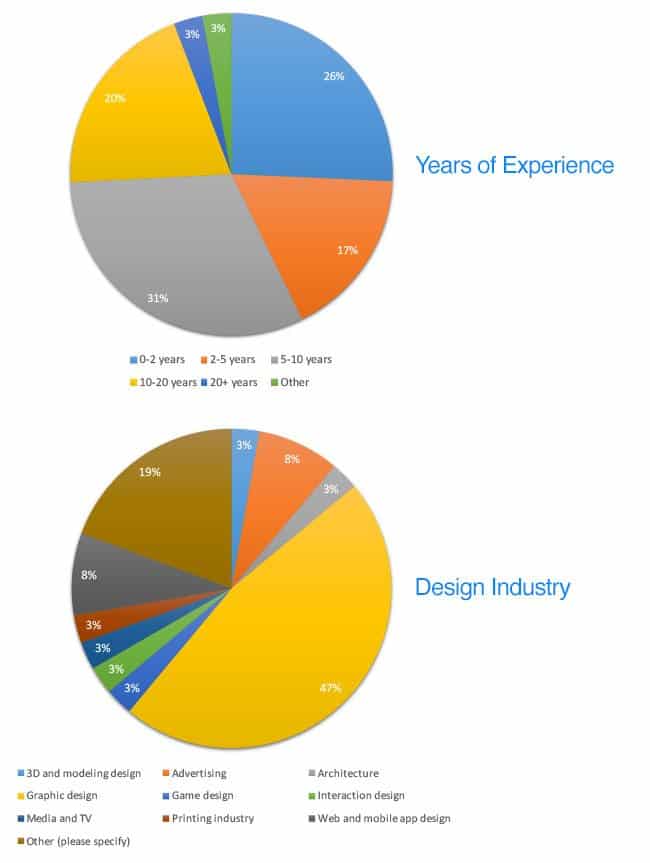
The career level of the participants varies from junior level to managerial level and business owners. Most of the participants are having middle career level as senior designers, team leaders, and art directors. Most of the attendees are a university-level graduate from both private and public universities in the MENA regions, yet the interesting observation here is that many of them are graduated from schools that are not related to design such as the faculty of science, faculty of commerce, tourism and hotel management, computer science…etc.
How Do Designers Learn Design?
In order to learn how designers learn their design skills, we asked them to share their learning source. based on the previous demographic information, it was obvious that the university was not on the top of their source of information as it presented 45.7% of the overall learn sources for the designers. However, the interesting observation here is that Youtube presented the highest source of knowledge for designers as 57% of designers depended on Youtube as a learning platform. The online training overall presented around 54.3% of the learning courses. Only 31% of the designers depend on books and 20% depend on training centers.
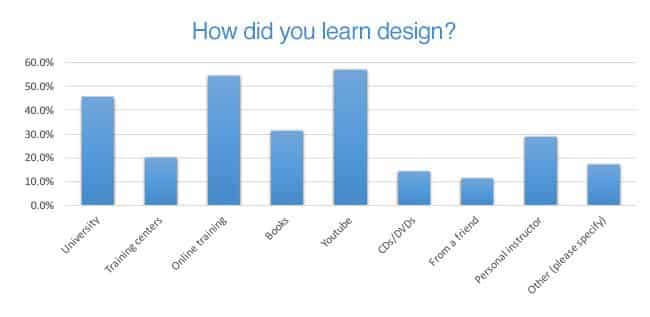
The above data presents a critical situation in the learning process for the majority of designers in the MENA region. While online learning sources and Youtube channels can present a good source of knowledge–considering the professionally and creditability of the material providers, it is needed to be used within a larger learning framework that helps designers to learn a combination of knowledge segments required for their career level including theory, practice, and technical knowledge. Additionally, they need to learn the side knowledge related to the design business and integration between design and different production teams.
As a result of the above-highlighted issue related to design education, design companies find it hard to find designers with the required skills to accomplish the targeted tasks. As the applicants either usually know a fragment of knowledge such as using the tools without learning the design principles or learn the design principles from a fine art or engineering perspective rather than a design background. These missing skills present barriers for the companies to reach high quality for the design outcome that subsequently reflects the company success in the market.
Rate the Design Education int he MENA
We asked the designers to rate the overall design education in the MENA region based on four criteria; design courses quality, the overall level of education, education costs and meeting with new design standards. While most of the designers rated the design education as moderate in all the criteria, there is an agreement that the design education costs are either high or very high, which presents one of the essential barriers for students who would like to learn design on an academic base to attend design schools in the region. The majority of the contemporary design education programs are offered in private or international universities that are known with its expensive tuition without offering sufficient scholarship or funding programs.
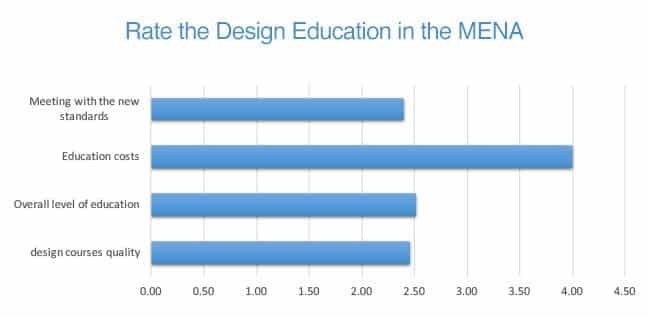
According to the above insights, we can identify the design education as the main barriers that face design industry in the MENA region, as many designers in the area can’t attend the academic design education that offers a balanced curricula between principles and applications due to the expensive tuition for the design education, the quality of the education, or the compliance with the modern design trends. Therefore, designers depend mostly on self-learning using the video channels, the Internet, blogs, books, and training centers to acquire the knowledge required to get a design job, which leads to unbalanced knowledge that reflects on the final design produced by different companies.
In order to improve the design industry in the Middle East and North Africa, a contemporary and affordable design education should be provided by different universities in order to support the large market needs for designers who can master both the design principles, the technology, and the skills that enable them to integrate with the other teams inside the company.





At the Interactive Design Institute (IDI) we currently have a number of students, and have also had a number of graduates who are based in the Middle East. They have chosen to study 100% online for a Bachelors Degree or MA from the University of Hertfordshire. Subjects include Graphic Design, Interior Architecture and Design, Illustration, Photography and Fine Art. Our students are registered with the University of Hertfordshire and the certificates they are awarded are identical to those awarded to students who have studied on campus. https://idesigni.co.uk/ We know that many students are far too busy with their day to day commitments to study at fixed times, and also many students don't want to give up their job and leave their families to move to another country to study design. Another advantage is the cost saving - the fees we charge are considerably lower than the international student fees charged by universities, and there is no need to pay for visas, travel and accommodation.
Dear Fiona, I know about the IDI and the contemperory design degrees offered through distance learning there. I beleove it is one of the good sourceof education for many students and designers who do not find good designs chool in their areas. I usually recommend the IDI for many fo my students, but it is amazing to know that you have students from the MENA region. This helps the design indsutry so much.
Hello Fiona
I think its still Expensive for Middle Eastern students, For me its too much expensive to pay 4000 Pound , when converted to my Currency it will be 80,000 EGP, which is so much expensive !
Dear Beshoy, thank you for highlighting this issue. I totally agree that the getting an online accredited degree costs a lot of money, yet the cost will be doubled if you travelled to UK to study there. Also, the pricing for IDI and similar degrees are set based on the British pricing. What I would suggest that if the IDI can consider scholarships for developed countries like Egypt, which can help reducing the tuition costs to allow lots the chance of lots of students from the Middle East area to get an accredited design degree. Thanks! Rafiq
I hope so, it will be amazing if they did it !