
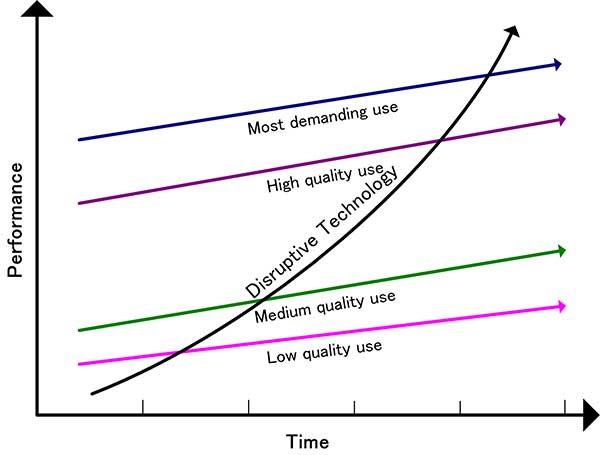
As people who continuously pursue creative change, designers need to understand the type of change that they are pursuing as well as how to achieve it. Change can be achieved through two types of innovation processes: Sustaining innovation and disruptive innovation. Sustaining innovation change is unlikely to create new markets or values, such as evolution innovation that improves existing products or revolutionary innovation that makes a change within an existing market. Unlike with sustaining innovations, disruptive innovation tends to create a new market by using a different set of values. While the sustaining innovations have less of an ability to build business success, many examples provide proof of disruptive innovation’s ability to dramatically open new opportunities for companies since they are creating a new market.
Designers are at the heart of the innovation process and their ideas contribute to the innovation process starting from the research stage through to the analysis of consumer feedback and experience regarding new products. Companies such as Apple depend on a dual team of CEOs and designers to innovate new products and services for their consumers. So it is important for designers to understand what type of innovation is required, and how to apply this to the innovation process.
Characteristics of Disruptive Innovation
Many managers find it difficult to define disruptive innovation and this confusion may expand to the production process and subsequently lead to failure; 60% - 75% of companies fail because they depend on sustaining innovations, which lead to sophisticated products that are too expensive or specialized for the consumers’ needs. While this unwittingly leads to disruptive innovation, clear understanding of the characteristics for disruptive innovations include the following:
Build a new market – One of the main characteristics that depicts the contrasts between the disruptive innovation model from Sustaining innovation is the ability to build a new market and include new consumers that were not part of the previous company strategy. The iPhone is an example of disruptive innovation that allowed the company to open a new market. However, it can’t be considered a disruptive innovation for the mobile industry.
Changing how performance is measured – Disruptive innovation creates a dramatic impact not only on the market but also in how the process or performance is measured. It can make a trending change in how we evaluate the product’s performance; products that we were satisfying us become obsolete and replaced by the new measurements implicated by studying the innovation. Kickstarter is an example of a disruptive innovation that changed the way we think in funding projects. It replaced the old rules and obstacles that small startups face in funding their projects, though the new measuring posts are changing the ordinary funding process through the crowd-funding model.
Adapt new business models – At the core of disruptive innovation, number innovation and business models are adapted, including open innovation, closed innovation, open and closed business models. Combinations from those four models results in new methods that can lead to concerted disruptive innovation. Uber implemented an open business model by using services from drivers who are not actually hired by the company and then evaluating the quality of service by reviewing feedback from both drivers and consumers. Uber is an example of disruptive innovation where the three main characteristics have been applied.
Achieving Disruptive Innovation
Observing disruptive innovation examples sure as Airbnb, Skype, and Twitter provide clues and a number of tips that can contribute to achieving this disruption. These tips have changed the way designers and innovation managers think during the entry phase of product development. These tips include the following:
- Investigate the small problems rather than the big ones. Most large companies focus on either obvious problems that have already been solved before by other companies, or in altering existing products and services provided by the company, which halts the company’s ability to create new markets. Small startups were able to achieve disruption because they think from the perspective of consumer needs and build new products that can fulfill these needs away from the large competition between big companies.
- Put yourself in the shoes of the consumer. Thinking as the consumer and observing how they live their daily life, how they use the different products, and what they love and hate about a product helps in building a vision about how to reach a product design that fits exactly with their needs.
- Focus on the consumer rather than the industry. As mentioned, focusing on the current production halts the ability for companies to focus on the needs of the consumer and then fill these needs with new products or services.
- Connect the disconnected. This method can drive innovative ideas and is one of the oldest creative thinking methods used by Leonardo Da Vinci to think of new inventions. This method can help build new products that people may not have thought of, such as merging the phone and camera to create a new service for mobile users who would like to take photos.
- Focus on a very narrow market segment rather than large or multiple business segments. Focusing on this segment contributes to reducing the cost and risks while also providing a better ability to observe the product, its behavior, and deliver innovative ideas based on these observations.

Conclusion
Although disruptive innovation holds high risk and costs more resources compared with the Sustaining innovation process, it has the capacity to change the market and open new opportunities for companies. Examples such as Apple, P&G, Uber, Airbnb, Skype, and others were able to change the game by adapting disruptive innovation. However, many managers are still confused about the definition of disruptive innovation and this is reflected on the production level, causing a high potential for failure. Disruptive innovation is characterized by its ability to 1) build a new market, 2) change how the business measures its performance, and 3) adapt new business models. Along with these characteristics, designers and innovation managers can apply a number of tips to help them reach disruptive ideas. In order to minimize the risks associated with disruptive innovation, focusing on small problems and narrow market segments should be considered to overcome the barriers to disruptive innovation.





Leave a Reply