
In order to have a clear vision about the new product development process, companies today are in greater need to write a creative brief. This is due to the nature of global markets in terms of infrastructure, teams, and competition. Companies are now able to connect through new communication methods that allow them to reach clients from the other side of the globe while their team is working from remote locations. Additionally, increasing competitiveness requires companies to clearly identify client requirements, document these requirements, and ensure that all the team is geared toward developing the product with the specification agreed on by both the company the client.
In a previous a previous article, we discussed the creative brief definition and How to Create a Professional Creative Brief. A creative brief is a document that includes the necessary information about the project. It is shared between the stakeholders involved in the creative process. Its purpose is to ensure that all the required information about the project and client strategy is clearly defined and understood by all parties.
Related articles:
The length of the creative brief and its included content have proved controversial topics. While some companies write a long document with all the details, others prefer to have a minimal creative brief that can consist of a few short sentences that define the project strategy and to address other details during the team meetings. However, both these groups agree on the importance and the purpose of the creative brief.
Download our Creative Brief Template for free personal and commercial usage.
Why Do we Need a Creative Brief?
As mentioned earlier, the new management models including outsourcing and offshore companies make it even more challenging for companies to build a clear vision about projects: especially when the company, teams, and clients are located in different places. Therefore, regardless of the length of the creative brief, it should achieve the following targets in order to be considered a successful and viable document to share with all the stakeholders:
1. Define
The first purpose of the creative brief is to define information about the project. The information that needs to be defined in the brief includes the project goals, strategy, and characteristics. While some companies jump directly to defining the project characteristics and specification, it is important to define both the client intended goal and the strategy in order to allow the team to have a broader vision about the project before getting into the details.
The goal of the project includes answering questions such as why this project is needed, and what the expected output of the project is. These goals should be supported by a clear strategy in order to create a clear vision for the team of what they are doing and why they are doing it in this particular way.
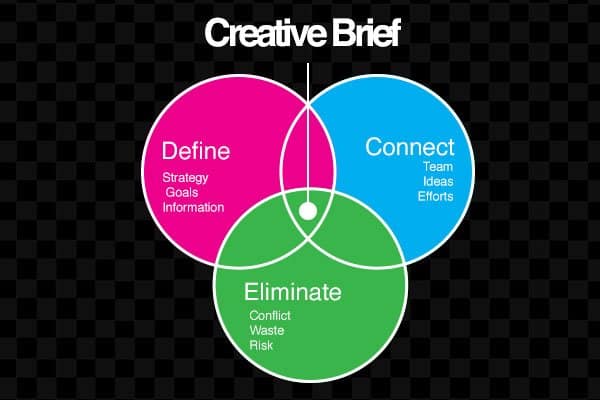
2. Connect
The second purpose of writing the creative brief is to build a connection between all the stakeholders involved in the project including the client, departments, teams, and freelancers. The connection is based on the three main areas: the team, the ideas, and the efforts. The creative brief should provide a unified document that can be used by the different teams to guide them through the product development process. Hence, the document shouldn’t be written to target specific any particular department. It should use language that can be interpreted clearly by different teams and for different objectives including the design, marketing, and management sectors in the company.

Another level of connection is the ideas. While these are not defined in the creative brief, the goals and specifications in the brief give the teams shared ideas about what ideas to adopt and how to implement them. The shared ideas come as a result of meetings that are held by the heads of departments on the one hand and the different teams on the other. The third connection that can be achieved through the creative brief is the efforts because the teams will have an idea about who is doing what. This knowledge increases the potential for collaboration and connecting activities to achieve more efficient integration between the teams.
3. Eliminate
The third group of goals of the creative brief is eliminating conflict, time waste, and risk. As a result of the connection and integration between departments and the clear vision within each department, the chances of conflict between departments is decreased. With a clear brief about the project specifications, a conflict that could be caused by an unclear vision about each team’s role is eliminated, which provides a better chance for strong integration between departments.

This integration helps to reduce the time waste that can occur when different roles are overlapping and prevents the need for teams to hold lots of meetings to follow up with each other progress and activities. Although the teams will still need to meet occasionally, the time wasted on making each team understand their role and how they should implement the requirements is reduced to a minimal level.
Obviously, the risk can’t be eliminated completely even when a creative brief is written defining all the required information. However, the brief can help eliminate part of the risk that can occur due to misunderstanding. For example, if the team builds a prototype that doesn’t meet the client’s requirements, this failure is a waste of time, cost, and effort.
Create Brief Recommended Books:
- How To Write An Inspired Creative Brief: 2nd edition
- An A-Z of Visual Ideas: How to Solve Any Creative Brief
While there is an agreement between companies on the importance of the creative brief, there is an increasing need to build clear and helpful creative briefs in companies. This is because of increasing competition and adopting modern management models such as outsourcing and offshore business. A creative brief helps define not only the project specifications but also the project strategy and goals need to be accomplished.
Also, the brief helps to create connections between teams, ideas, and efforts by providing a clear vision about each department’s role based on the brief’s specifications for the project. Additionally, the brief helps to eliminate conflict between stakeholders, time waste resulting from unclear information about the project, and to reduce the risk of moving in the wrong directions.





Leave a Reply