
The Human Being used stories since the dawn of civilization to as a method for communication, amusement, reflecting emotions, and telling their experience. Stories are a great tool to visualize information through words and human expressions and were always used as one of the education tools for children in different education levels. In service design, storytelling is commonly used to reflect the consumer experience during the design process.
One of the challenges that face designers in different projects including service design is to ensure that the problem is well-defined and there is a common understanding of the problem being addressed by all the stakeholders in order to ensure successful formulation and implementation of the solution. Storytelling can be used to achieve this target as it is a flexible design research method that is used on wide range of applications. It can be used in different stages of the design process and can be presented in different forms such as storyboards, photos, videos, and wireframes….etc.
Related articles:
- How to use Card Sorting to Improve Service Design
- How to Use Task Analysis Grid in Service Design
- Service Design Thinking: Putting Your Consumer First
When Storytelling is Used in Service Design?
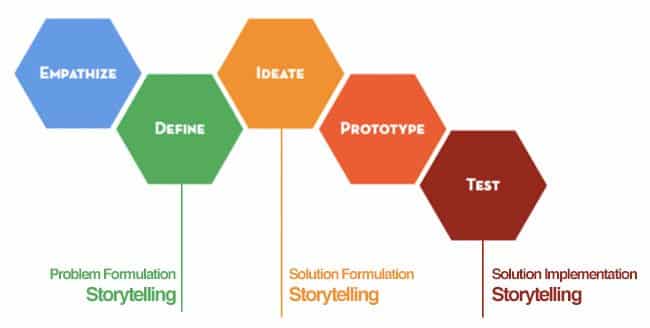
There is always a place to tell stories in different stages of the project. The storytelling can be used in different phases of the project including; problem formulation, solution formulation, and solution implementation as following:
Problem Formulation
Usually, the definition of the consumer's problem comes at the early stage of the design process in order to use the clear understanding of the problem in the following stages over the course of finding the proper solutions. The storytelling can be used at this stage as a co-design tool to capture the consumer expressions and problem and gather the feedback from the different consumers in a form of a story that can be shared with all the stakeholders to ensure they are all on the same ground of understanding the problem being addressed.
Solution Formulation
At this stage, the storytelling acts like a collaborative tool to help stakeholders to engage and communicate together to export different solutions. It helps to transfer the experience to the stakeholders in order to explore the possible solutions. It can be used during the ideation phase where the team is investigating the different solutions for defined problem.
Solution Implementation
After the prototyping phases, where the solution is being tested, the storytelling can play another role to validate the solution and ensure it solves the problem defined earlier int he project. The storyteller uses the different characters and scenarios in the story to ensure that the prototype is functional and helps for the end consumer.
How to Tell a Great Story
Actually, no one is born as a storyteller. In order to deliver the emotional experience for either the problem or the solution in the service design project, you should have the basic elements that can help your audience to engage with you in the story. Using the storytelling in service design requires having a clear definition for main two elements; the domain and the demographics. The domain refers to the problem that needs to be highlighted in the story or the social issue that will be addressed during the story events. The demographic refers to the individuals in the story and the scenarios they experienced.
After defining the problem and the characters involved in the story, the story process itself follows a specific pattern, which is formed around a character or specific theme. In the below figure, the story takes a typical arc. Usually failing to affect the audience emotionally is closely related to failing to follow this pattern.
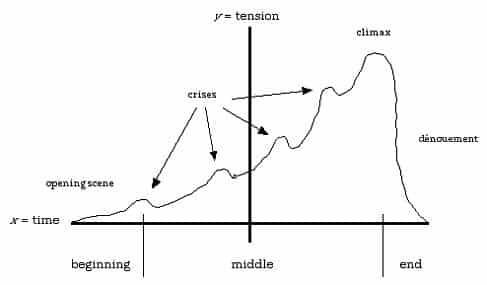
At the beginning of the story, the character reacts with the scene around, which is called the opening scene. Then, the character starts to face a number of crisis or problems over the course to reach his or her goals. This is the middle episode where the character faces the different problems. This episode ends with the highest peak of the problems which is known as the climax. Then at the end, the user denounced from the scene (dénouncement).
How to Visualize Your Story
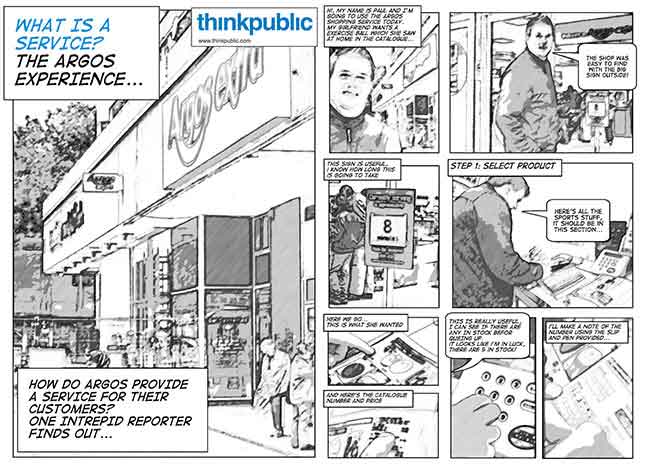
While storytelling involves building a visual image about the problem and the consumer experience through words, a picture can still worth thousands of words. Aligning your story with a visual representation can help you to grab the stockholder attention to details and keep them engage with your story. Also, it can help you to share the story through emails, and other communication threads with other parties in the company. The storytelling can be visualized in different formats including photos, videos, animation, sketches, wireframes, storyboards, and mock-ups. The Example below shows how the storytelling was visualized in a form of a storyboard using simple words to reflect the problem the face consumers.
What Makes a Great Storytelling in Service Design
In his research, Beyond scenarios: the role of storytelling in CSCW design, Gruen highlighted a number of points that can help you build a great story and use it as a tool in service design and design research. These points include the following:
- Detailed information about the characters involved in the story;
- Rich and include contextualized settings;The goal that needs to be achieved inside the story;
- The goal that needs to be achieved inside the story;Causality (the relation between cause and effect); and
- Causality (the relation between cause and effect); andObstacles that prevent the character from achieving planned goals
- Obstacles that prevent the character from achieving planned goals
What is Next
Storytelling can be a good advantage for designers to help them build a clear communication and engagement between the stakeholder and the problem, yet it is a talent that can be improved by practice. So, it is important to practice the storytelling in a different situation with keeping in mind the story elements, pattern, and the factors can that can contribute to creating a good reflective story.
While the storytelling is used as one of the design research methods, it can be implemented in the service design to reflect the consumer emotional experience and the problems they face when using a specific service. It helps to build a clear understanding of the problem between all the stakeholders and subsequently reaching a targeted solution.





Leave a Reply