
Summary: Open innovation is a model in which creative ideas come from both internal and external sources to increase an organisation's innovation capacity, usually through partnerships and collaborations with other companies, as well as by involving end consumers in the idea-generation process.
Innovation and creativity are essential factors for achieving a competitive advantage in the market. Innovative companies adopt strategies that aim to improve both the input and output sides of the innovation equation by reducing the input costs or increasing the production volume. All types of innovation, including both open and closed innovation, can be applied at four primary levels within the company: business model innovation, product & service innovation, process innovation, and technology innovation. However, the innovation process faces obstacles at those four levels. For example, the product development process faces challenges such as a short product lifecycle, high innovation costs, and increasing product complexity across releases. The company's R&D team should overcome these obstacles.
What is Open Innovation?
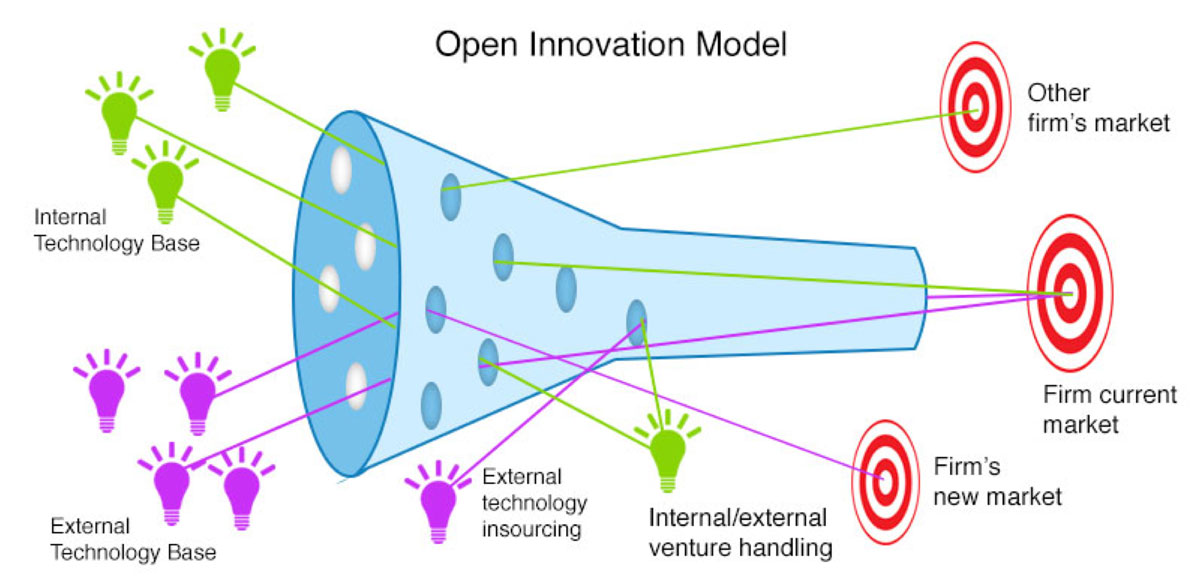
Open innovation is a business paradigm in which firms use internal and external ideas to advance their technology, opening both internal and external paths to market. Figure 2 represents the diagram of an open innovation model. At the same time, the innovation process is divided into two main stages: research and development. The research phase includes inputs from outside the company. Many companies provide successful examples of innovation models to solve problems, such as IBM (IBM Design Thinking Model: A Shift Toward Big Enterprises), which patterned itself after other companies to develop semiconductor technologies. Apple and P&G implemented open innovation to create new products. Other companies used the open innovation model to build new business models, such as Facebook, Salesforce.com, IBM, and Linux.
What is open innovation? And Why is it important?
Closed versus Open Innovation Model
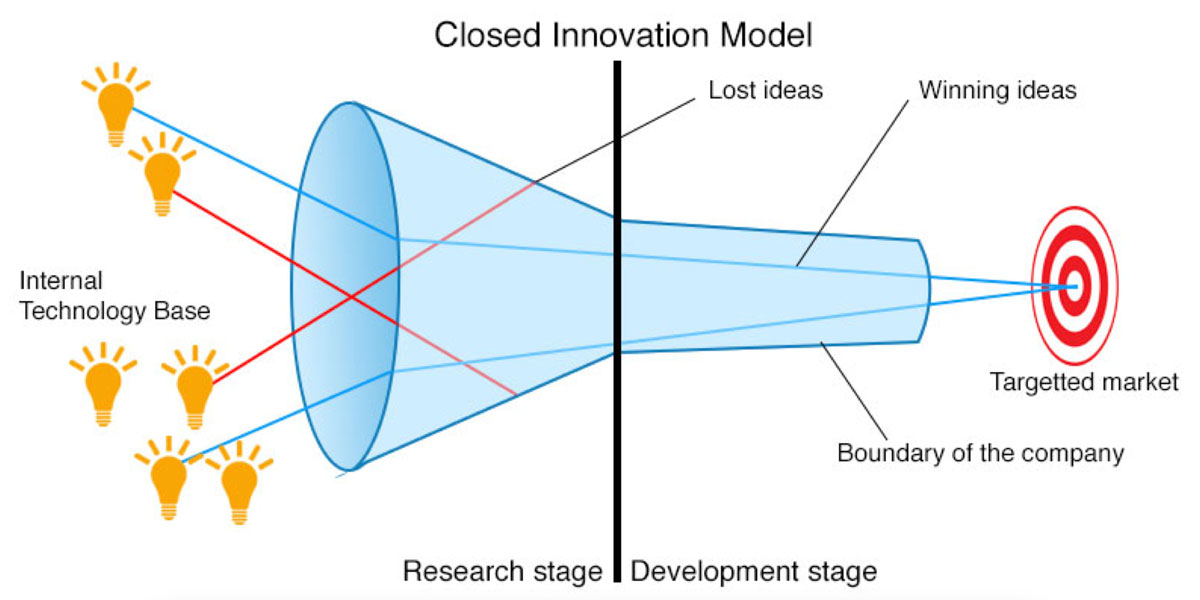
In the traditional closed innovation model, the R&D process relies on internal laboratories and resources, while new ideas and technologies are developed and presented by internal teams. The closed innovation model in Figure 1 represents the flow of creative ideas inside the R&D process. The dashed line represents the company's boundaries, within which all creative ideas are produced. Creative ideas flow to the research stage, where selected ideas are filtered and refined. Selected ideas are moved to the next development stage. Winning ideas are presented to the market through new, innovative products or services.
On the other hand, the open innovation model aims to combine internal and external use of innovation and technologies to provide a larger, or possibly more efficient, flow of ideas to the research stage compared with the closed innovation model. Figure 1 presents the open innovation model, showing that creative ideas come from within and outside the company’s boundaries. The closed and open innovation models indicate a strong correlation between research and development. Open innovation is also introduced to balance short-term financial interests with long-term innovation requirements within the firm. The profit gained from external knowledge can reduce the internal investment in the long-term research process ( check The Double Diamond Design Thinking Process and How to Use it).
| Area | Closed Innovation | Open Innovation |
| Source of ideas | Ideas mainly come from internal teams. | Ideas can come from both inside and outside the organisation. |
| Company boundaries | Innovation activities are mostly internal and protected. | Knowledge, ideas and technologies can flow across its boundaries. |
| Collaboration | Collaboration is limited and usually happens inside the company. | Collaboration may involve customers, suppliers, universities, startups, developers, designers and research partners. |
| Risk | The company carries most of the innovation risk alone. | Risk can be shared with partners. |
| Speed of innovation | Innovation can be slower because it depends mainly on internal resources. | Innovation can be faster because the company can access external expertise and existing solutions. |
| Cost | R&D costs are usually carried internally. | Costs may be reduced by sharing with external partners. |
| Intellectual property | Intellectual property is tightly controlled. | Intellectual property may be licensed, shared, co-developed or commercialised through partnerships. |
| Customer involvement | Customers are usually involved later, after the product is developed. | Customers can be involved early through feedback, co-creation, testing and idea submission. |
| Best suited for | Highly confidential projects, protected technologies and industries where control is essential. | Complex problems, user-centred products, digital platforms, ecosystem growth and fast-changing markets. |
Table 1. Comparison between Closed and Open Innovation Model.
Why the Open Innovation Model Matters
Henry Chesbrough developed the open innovation model to enable companies to combine internal and external ideas from partners to achieve product innovation and consumer satisfaction. In contrast to the closed innovation model, six characteristics can be identified for the open innovation model:
- While the closed innovation model assumes that the resources and employees who can generate innovative ideas are located within the organisation, open innovation holds that innovative ideas are not confined to the company’s boundaries. The ideas can be driven by external and internal sources. Check out the 5 Successful Open Innovation Examples.
- The closed innovation model assumes that, to achieve the targeted profit from innovation, internal employees should discover and manage ideas. However, the open innovation model values external ideas and is open to the values that can lead to the target’s profit and market advantages.
- While the traditional innovation model is based on the expertise that internal resources should discover and manage to achieve market leadership, open innovation aims to merge external innovation with internal management.
- While the closed innovation model prioritises leading the market with new ideas, open innovation emphasises that a company should engage in basic research to benefit from it.
- The closed innovation model assumes that internal resources are needed to produce the most innovative ideas to lead the market. On the other hand, open innovation depends on utilising internal and external ideas and merging them.
- The closed innovation model aims to limit the innovation profit to the company by giving the company full control over the innovation process. On the other hand, open innovation aims to utilise all available resources to achieve an efficient process.
The open innovation model provides a non-traditional approach for a company to utilise creativity from internal and external resources. This model leads researchers to believe it can foster more creativity within organisations. However, the open innovation model faces several challenges that could, in turn, inhibit creativity within the organisation. Therefore, a clear understanding of the company’s boundaries and identity must be considered to evaluate the creative potential inside the organisation's strategic thinking.
Types of Open Innovation
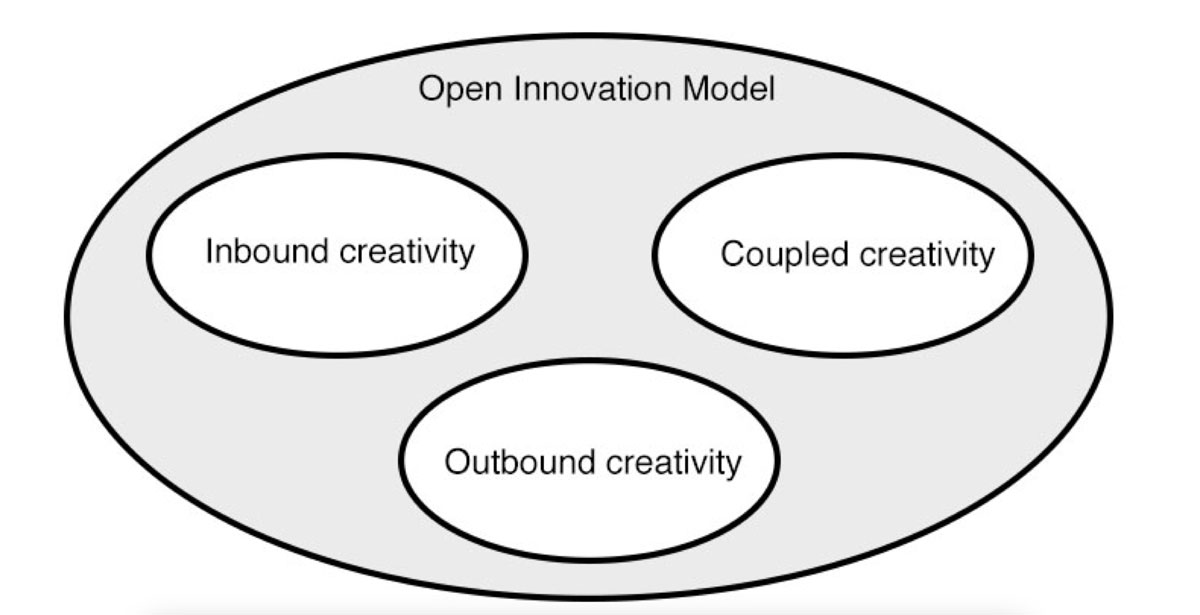
While many companies adopt innovative strategies to compete in the market, it is crucial for them to understand the types of innovation and how it happens, so they can clearly manifest this strategy and competitive advantage in the market. Additionally, this understanding will directly affect how the design process operates. In the early development process, the team faces several questions about “what should be innovated?” and “how to innovate it?” Answers to similar questions can be provided by understanding the different open innovation types within the open innovation model, which can be classified into inbound, outbound, and coupled perspectives, as shown in Figure 3.
Inbound innovation
When the company does not know what to innovate, inbound innovation can inspire the team with ideas from external sources, such as customer feedback, user needs, or market gaps. This external knowledge guides the organisation's innovation process, enabling the development of products and services that meet end-user expectations. Deutsche Telekom, for example, uses insights collected about consumers in their environment to develop innovations within the company. Procter & Gamble developed innovation models such as (connect and develop), and every year, the company identify the top ten of its consumer requirements and needs. The R&D department used this collected information in the research and innovation process. Inbound creativity enhances innovation within the firm by monitoring the operating environment and collecting information from partners.
Outbound innovation
Outbound innovation refers to ideas or failed products that may not work well within the company but could succeed outside it when marketed through an innovative business model rather than being implemented within the company of origin. The Ethernet network protocol, developed at the Palo Alto Research Centre by Xerox, is an example. To reduce the costs, Xerox leased the technology to a former employee, whose spin-off was named 3Com. Although the initial use of the technology was limited to the company’s business scope, the spin-off achieved greater success under the new marketing strategy.
Coupled innovation
Coupled innovation works similarly to the inbound innovation model. The difference is that coupled innovation aims to build a partnership to collect information from the operating environment. One example is the Ecomagination Challenge, presented by General Electric in 2010. A consortium of organisations, research institutes, universities, NGOs, and individuals was invited to present their ideas for creating smart,efficient grid technologies. A committee evaluated ideas, and the winner received a prize, investments or a commercial relationship. The example provided by GE indicates that the company drew on external knowledge to develop an innovative product that met market needs.
Tom Hulme, Founder and Managing Director of OpenIDEO, speaks about open innovation and collaboration at London Business School’s Global Leadership Summit.
The closed innovation model limits the ability to generate new ideas (What is the 8D Problem Solving? And How to use the 8D Report?) because it depends solely on the company’s resources. In contrast, open innovation maximises the opportunity to develop innovative ideas by expanding the company’s creative capability through internal and external resources and knowledge through the different types of innovation. As a result, the model creates a better creative environment and maximises the likelihood of developing innovative products that succeed in the market.
How to Apply Open Innovation
To adopt an open innovation model within the organisation, companies should have a clear idea of the procedure or steps to follow. This will help create a practical way to achieve what we have discussed above. While there is no clear process to adopt, observing open innovation examples can provide a guide to the key steps to follow:
- Define the innovation challenge
The first step is always to identify the innovation challenge or the problem that we need to solve. This can be a business goal, such as developing a new product, dealing with a failed product, or improving an existing one. - Identify possible knowledge sources
Second, the team explores the various aspects of the idea under discussion. These aspects can be assets, collaborators or end consumers who can be involved in the business model. - Choose the right open innovation model
Once the team has a clear idea of the business goal, assets, and collaborators, they begin identifying which open innovation model aligns with the organisation's capabilities and goals. - Create rules for collaboration
Once the team defined the collaborators, they began exploring the terms and conditions governing the relationship between the company and its partners. This will help protect the ideas and prevent future disputes. - Evaluate and prototype ideas
There should be a clear idea of how to evaluate the flow of ideas, their value, feasibility, cost, and how they fit with the company's strategy. - Connect innovation to the business model
The innovation model should integrate with the organisation's existing business model. This will help streamline the ideas and turn them into products inside this business model. - Measure the outcomes
The impact of the open innovation model can be measured through various parameters. such as the return on investment, created opportunities, and impact on consumer experience (check those co-create and open innovation examples).
Open Innovation Examples
Both innovation and business models applied within the company are connected. While the R&D department contributes to research and innovation in product development, the business model completes the production process to deliver the final product or service. Chesbrough and Vanhaverbeke (2014) highlighted the relationship between the open business model and the value of creating, capturing, and delivering new products and services to the market. In contrast, in the closed business model, firms depend on their assets and chain partners through marketing transactions. This connection can be illustrated through the examples of open innovation below.
Inbound open innovation examples
Inbound innovation, combining external knowledge with the closed business model, is commonly used by different companies. P&G is one of the companies that has successfully brought to market innovative ideas developed by external partners, such as Swiffer Dusters, Tide Pods, and Olay Regenerist. In open business models, inbound innovation can be leveraged to create a new business model. Another similar example is Apple's case study, the mobile apps opened to external producers such as the App Store, to sell their mobile applications, turning the product into a new development platform and adding more value with each application.

Outbound open innovation examples
In the closed business model, unused knowledge is transferred to others. This model is used in most licensing agreements and spin-offs. The technology is transferred from the original manufacturers to the recipient, who completes the production process and introduces it to the market. The original innovator is not involved in the product development after the technology is transferred to the new company. Outbound open innovation can also be combined with open business models to make internal knowledge accessible to others for the development of new business models. For example, IBM has supported Linux through patents and invested $100 million annually to compete with Microsoft's operating system (How Inclusive Design Reshaped Microsoft Products).

Combining the different open innovation types with both closed and open business models can maximise the potential of the innovation and creativity process. Innovation costs become less risky when the innovative product or technology can be implemented across different channels, depending on the business model and the degree of open innovation used in the R&D process. For example, the Apple iPhone gained greater market value by shifting from an innovative product to a platform for third-party app development. On the other hand, investing in a partner’s innovation process, as IBM did with Linux OS development, improves the competitive position against strong competitors such as Microsoft.
The Innovation in Lego
LEGO is one of the leading companies in the toy industry, having led the market through innovation and creativity. The company was founded in 1932 by Danish carpenter Ole Kirk Christiansen in the Danish village of Billund. The company began manufacturing furniture and small items such as stepladders, ironing boards, and wooden toys. The Lego innovation model aims to help the company achieve three main targets: participate in discussions during the early stage of production, understand the knowledge and resources required to succeed, and assess results against the company's objectives at different project stages. Based on these goals, LEGO’s approach was that instead of changing their current process and product, the company needed to apply minor changes and optimisation of the known issues in the products and process, reconfigure the existing parameters to meet the consumer needs and redefine new approaches to the product’s level while modifying the existing process and products.
The open innovation strategy has been implemented in LEGO on both the process and production levels. Erik Hansen, LEGO’s Senior Director of Open Innovation, adopted open innovation and crowdsourcing strategies to drive the company's success. Erik’s plan is based on assessing the existing opportunities, needs, and benefits for implementing open innovation in the company. LEGO’s open innovation strategy focused on three main elements:
- Learning from external companies through interviewing twelve of the leading open innovation firms.
- Learning from internal practitioners through feedback and interview methods.
- Building micro pilots to test the company’s capabilities, consumer culture, and needs.
The innovation process is organised in LEGO into eight types: product development and business model innovation. Responsibility for the innovation process is shared among four functional groups: the Concept Lab, the Product and Marketing Development, and the Communication, Education and Direct Unit.
In addition to the process level, LEGO implemented an open innovation model to improve its products through new ideas from external sources. These resources can be linked to their existing clients or other companies with experience in open innovation. In 2008, LEGO launched LEGO Ideas, an open platform for anyone to submit innovative ideas. LEGO received proposals from 10,000 users. These ideas have been reviewed, and the winning idea has been moved to the production process. The original owner of the idea receives 1% of the royalties from sales. LEGO Ideas was the catalyst for introducing new sets such as Big Bang Theory, Ghostbusters, and Back to the Future. LEGO IDEAS can be accessed through the domain name https://ideas.lego.com.
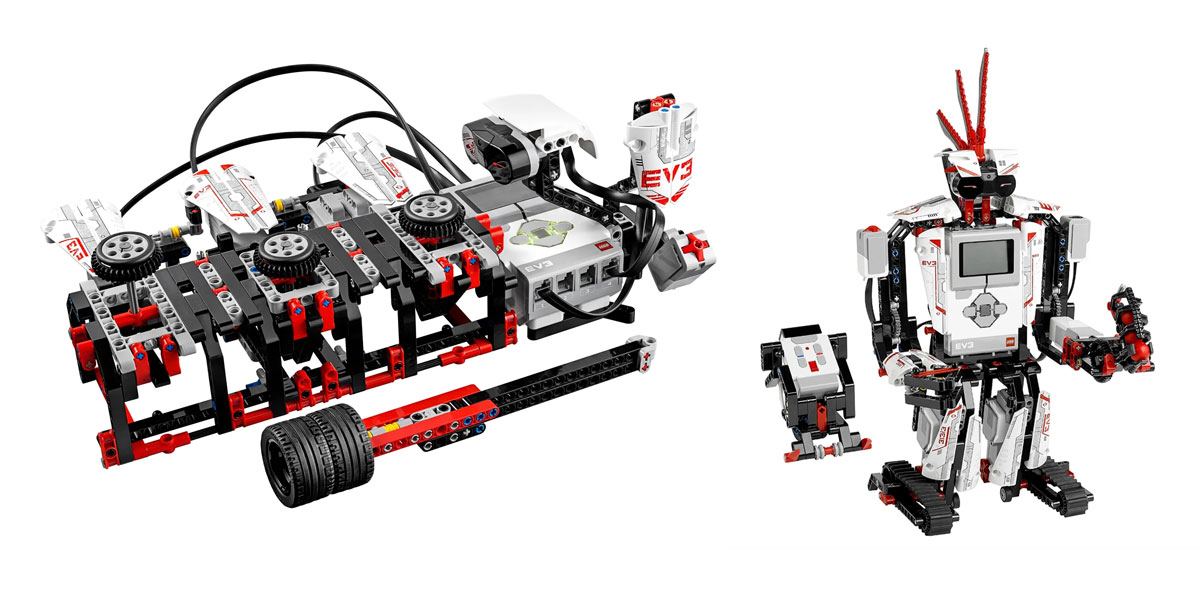
Co-creation is another tool in an inbound open innovation model for developing products through collaboration with external organisations. LEGO’s executive team built a partnership with the MIT Media Lab to deliver programmable bricks, which were introduced as LEGO Windstorm. The new product was initially introduced as an educational tool to teach children robotics, as they could build LEGO models that could move. Its software was closed in an early product version and could only be edited by unauthorised modifications to add more functions. Later, LEGO opened the software to expand the innovation space among consumers. Another innovation dimension can be observed in LEGO’s partnership with the MIT Media Lab, which is shifting from closed to open-source software. Someone was able to hack through the LEGO software that comes with the motors to apply more functions. While this was considered illegible by many, LEGO made the software open so anyone can modify it to see what end consumers can create. This approach has a positive impact on the company and the curriculum developed in the United States to teach students robotics. Although the product was initially introduced as an educational tool, it gained popularity and acceptance among both adults and children.
LEGO provides a practical example of applying two levels of the open innovation model: inbound innovation through listening to ideas from external consumers and companies, and coupled innovation through its partnerships with external organisations such as the MIT Media Lab. Both the inbound and coupled open innovation models helped the company improve internal processes and establish a solid linkage between creative and business targets, on the one hand, and present new products to the market that were not their original intention, such as programmable bricks, on the other.
Conclusion
Both closed and open innovation models have been implemented into company business models to achieve competitive advantages in the market. While the closed innovation model depends on internal resources and assets to generate new ideas and technologies, the open innovation model extends the company's ability to create and innovate through the use of external resources and the company's partnership capabilities.
The open innovation model can be applied at different levels: inbound, outbound, and coupled innovation. The inbound creativity model identifies that the R&D department can draw on external resources to generate ideas and technologies to answer early-stage innovation questions, such as “What should be innovated?” and “How to innovate it?” Outbound creativity assumes that products that fail within the company can succeed outside through marketing, using a different business model. Coupled creativity is similar to the inbound model. The difference is that coupled creativity aims to build partnerships with other companies to gain market advantage.
Implementing an open innovation model can drive innovation and creativity within the organisation on both the process and production levels. Each level of creativity within the open innovation model has distinct characteristics and outputs when combined with different business models.
Bibliography
Bucic, T. and Ngo, V. (2012) Examining drivers of collaborative inbound open innovation: Empirical evidence from Australian firms. International Journal of Innovation Management, 16(04).
Bughin, R., Chui, M. and Johnson, B. (2008) The Next Step in Open Innovation. The McKinsey Quarterly, 4, pp. 113.
Chesbrough, H. (2007). Why Companies Should Have Open Business Models. MIT Sloan Management Review, 48(2), 22–28.
Chesbrough, H. (2010). Business model innovation: opportunities and barriers. Long-range planning, 43(2), 354-363.
Chesbrough, H. (2011). Bringing open innovation to services. MIT Sloan Management Review, 52(2), 85-90.
Chesbrough, H. (2012) GE’s ecomagination challenge: An experiment in open innovation, California Management Review. 54 (2012), 140–154.
Chesbrough, H. W. (2003). Open innovation: The new imperative for creating and profiting from technology. Boston: Harvard Business Press.
Chesbrough, H., Vanhaverbeke, W., and West, J. (2006). Open Innovation: Researching a New Paradigm. Oxford, GBR: Oxford University Press, UK. Council, D. (2007). Eleven lessons: managing design in eleven global companies. London: Design Council.
Design Management Europe Award. (2009) DME Award Poster: LEGO. [Online] Available from: https://www.dmeaward.com/wp-content/uploads/2013/07/LEGO.pdf. [Accessed: 6th May 2015]
Henkel, J. (2006). Selective revealing in open innovation processes: The case of embedded Linux. Research Policy, 35(7), 953-969.
Huston, L. and Sakkab, N. (2006) Connect and Develop: Inside Procter & Gamble’s new model for innovation, Harvard Business Review 84 (2006), 58–66.
Lauwaert, M. (2008) Playing outside the box–on LEGO toys and the changing world of construction play. History and Technology, 24(3), 221-237.
Marques, P. (2014). Closed versus Open Innovation: Evolution or Combination? International Journal of Business and Management, 9(3), p196.
Nerone, M., Osiris J., and Liao, Y. (2014). Classification of Open Innovation Practices: Creativity Level Brazil: IOS Press.
Oberoi, P., Haon, C., & Bodas Freitas, M. (2014). Organising for Open Innovation: Incorporating the Externality of Control with Diversity of Contribution. Management, 17(3), 180-192.
Robertson, D. and Hjuler, P. (2009) Innovating a Turnaround at LEGO. Harvard Business Review, 87 (9), pp. 20-21.
Rohrbeck, R., Hoelzle, K. and Gemünden, H. (2009) Opening up for competitive advantage – How Deutsche Telekom creates an open innovation ecosystem, R&D Management 39 (2009), 420–430.
Simic, D. (2013). Applied Open Innovation – A Case Study Analysis based on Electric Drive Technology Projects in the Automotive Industry. Vienna: Austrian Institute of Technology
Strazdas, R., & Cerneviciute, J. (2015) System Innovation Approach for Improvement of Innovation Development in Creative Industries. Researchgate.
Teece, J. (2010) Business Models, Business Strategy and Innovation. Long Range Planning, 43(2–3), 172–194.
Weiblen, T. (2014). The Open Business Model: Understanding an Emerging Concept. Journal of Multi Business Model Innovation and Technology, 1, 35-66.
Westergren, H. (2010). Open Innovation Success or Failure: The Impact of Contextual Factors. In System Sciences (HICSS), 2010 43rd Hawaii International Conference (2010) pp. 1-10.
Wit, J., Dankbaar, B. and Vissers, G. (2007). Open innovation: the new way of knowledge transfer?. Journal of Business Chemistry, 4(1), 11-19.
Wolf, J. (2014). LEGO Studies. New York: Taylor & Francis.





Leave a Reply